

Termite control in Jeddah from Gulf Al-Arab Company starts with an inspection of your woodwork and walls. The team then chooses between spot treatment of doors and wardrobes, soil injection under the tiles to build a barrier the colony cannot cross, or soil spraying before the concrete is poured on a new building. Spot treatment starts from SAR 93, injecting a single door starts from SAR 74, and you can book a visit by phone or WhatsApp on 0501533146.
Termite control in Jeddah at a glance
- Local names: Etta, Ardha and Ramma — all the same wood-eating, cellulose-feeding insect
- First sign: Pencil-wide mud tubes on a wall, or shed wings piled by the windows
- Spot treatment: From SAR 93 for a limited infestation in doors or wardrobes
- Injecting one door: From SAR 74, through small holes that are sealed afterwards
- Villa soil barrier: From SAR 465, depending on the length of wall treated
- Before the concrete pour: From SAR 2,790 per project; the area is measured on site
- Contact: Call or WhatsApp 0501533146
How much does termite control cost in Jeddah?
Termite control in Jeddah starts from SAR 93 for spot treatment, and the price rises with the number of affected doors, the length of wall that needs injecting, and whether the termites are living only in the wood or coming up from the soil. That is why termites never have one flat price the way a cockroach spray does: one door in a third-floor flat is a completely different job from a villa with a garden and wooden floors whose walls sit on the soil.
We set the price after a quick inspection that shows us where the mud tubes are and how deep the damage goes, and we tell you the figure before any work starts. The table shows the starting point for each type of job:
| Service | Details | From (SAR) |
|---|---|---|
| Spot treatment | An inspection and treatment visit for a limited infestation inside the wood in a flat | 93 |
| Door injection | Per extra door within the visit: fine holes in the frame and jamb, injected and sealed | 74 |
| Soil barrier for a villa or ground floor | A row of holes drilled along the walls and the soil under the tiles injected | 465 |
| Pre-construction treatment | Compacted soil sprayed before the plastic sheet, the concrete and around the footings | 2,790 |
| Termite bait stations | Monitoring stations in the garden and yard, checked on a schedule | Ask for the price |
| Warehouses and businesses | An inspection, injection and follow-up plan for stores, offices and shops | Ask for the price |
Three things usually push the price up: an infestation that has reached the gypsum ceilings or the space under parquet and needs a wider search, marble or granite floors that must be drilled with extra care, and large villas with boundary walls, annexes and outdoor service rooms. What brings it down is catching it early — an infestation treated while it is still in one door costs far less than one left until it reaches the kitchen and the bedroom wardrobes.
Termites or ordinary ants? A simple check at home
The quick answer: termites are pale, almost cream-coloured, with a thick body and no waist, and they do not march in open lines like black ants. They move inside the wood or inside mud tunnels they build up the wall. If you see insects walking in a column across the marble towards the sugar, those are most likely ordinary ants — we cover them separately in ant control in Jeddah.
What confuses people most is the flying season. On hot, humid days the colony releases winged insects that gather around lights and then drop their wings. Those shed wings on window sills and under lamps are an important clue: termite wings are all roughly the same length, while a flying ant has front wings longer than its back wings.
| Feature | Termites (Etta) | Ordinary ants |
|---|---|---|
| Waist | Thick body with no visible waist | A narrow waist between thorax and abdomen |
| Antennae | Straight, like a string of small beads | Bent at an angle, like an elbow |
| Wings when swarming | Two pairs of about equal length that drop off easily | Front pair longer than the back pair |
| How they move | Inside wood or in mud tubes, away from light | Open trails across floors and walls |
| What they eat | Wood, paper, cardboard — anything with cellulose | Sugars, fats and food scraps |
| Damage | Silent damage to doors, frames and wardrobes | A nuisance and food contamination, no structural harm |
Try this yourself: tap a door frame with the handle of a screwdriver from the bottom up. Sound wood gives a solid knock; wood that termites have eaten sounds hollow, or the tip of the screwdriver sinks in easily. If you break off a small piece of mud tube and see pale insects moving inside, there is no need to doubt it — leave the rest of the tube alone so the technician can follow the whole route.

Signs of termites at home: where to look first
The clearest sign of termites in a Jeddah home is mud tubes on the walls and at the foot of doors, followed by woodwork whose paint bubbles or flakes, and then shed wings. The reason is simple: termites dislike light and dry air, so they build passages of soil and saliva that keep them moist as they climb from the ground to the wood.
Mud tubes
Brown lines about the width of a pencil climbing from the tiles to a door jamb or running behind the skirting.
Bubbling or cracked paint
Small blisters in the paint on doors and frames, or wavy lines beneath it, often mistaken for damp.
Doors that suddenly stick
Mud and moisture inside the frame change its size, so the door becomes hard to close.
Tiny pellets
A small pile like grains of sand under a piece of furniture — the mark of the species that lives in dry wood.
Shed wings
Clear wings of equal length on window sills and under lights after hot, humid nights.
Damaged paper and boxes
Cartons stored on the floor of a storeroom or under the stairs showing gnawing and soil.
The first places to search in a typical Jeddah home are well known: the bottom of bathroom and kitchen doors where humidity is higher, behind wooden skirting, under the kitchen sink where the cabinets meet the wall, the corners of ground-floor rooms next to the garden, and false ceilings with a dripping air-conditioning line above them. In villas we add the guard room and the outdoor storerooms, which usually sit close to the soil and are full of cardboard.
Why are termites so common in Jeddah?
Termites are common in Jeddah because coastal humidity stays high for most of the year and the soil in many districts is sandy and damp close to the surface — comfortable conditions for the subterranean species, which lives in the soil and needs water to survive. The problem grows in homes with leaks from an underground tank or a bathroom, gardens watered right up to the wall, or leftover construction timber buried under the soil.
In the newer districts of north Jeddah and along Obhur the question comes up often, because much of the land was open ground before building and the timber formwork left under the slab becomes a ready food source. In the older central districts the problem is usually old wooden doors and ceilings that have been exposed to damp for years.
- Leaks from the underground tank and drain pipes under the tiles keep the soil around the foundation wet.
- Watering trees and lawns right up to the wall keeps the strip next to the foundation permanently damp.
- Wood touching the soil, such as pergolas and timber fences, acts as a direct bridge for the colony.
- Cardboard and paper stacked directly on a storeroom floor are easy food and a safe hiding place.
- Cracks in the tiles and expansion joints open a route from the soil into the house.
Termite treatment methods: when do we inject and when is wood treatment enough?
The right termite treatment depends on where the insects are coming from. If they come from the soil, treating the door is not enough — you need a soil barrier that cuts the colony off. If they live inside a piece of dry wood well away from the ground, local injection of that piece is enough. That is why we name the method after the inspection, not before it.
We use products registered with the competent authorities and made specifically for termites. Among the most widely used are non-repellent termiticides, which the insects cannot sense, so they pass through them and carry them back to the rest of the colony, along with baits containing growth regulators that stop termites from moulting. The table compares the options:
| Method | When it fits | What to expect |
|---|---|---|
| Soil injection (barrier) | Termites coming from the ground, tubes rising from the tiles, villas and ground floors | Small holes along the wall sealed with tile-coloured filler, and a long-lasting result |
| Spot wood treatment | One door, wardrobe or wooden ceiling with a limited infestation | Fine holes in the wood and direct injection, without disturbing the rest of the home |
| Bait stations | Gardens and yards, or places where drilling is not possible | Works slowly over weeks to months and needs inspection visits |
| Two methods together | An advanced infestation in more than one room | A soil barrier plus treatment of the affected doors in the same visit |
Soil injection along the walls
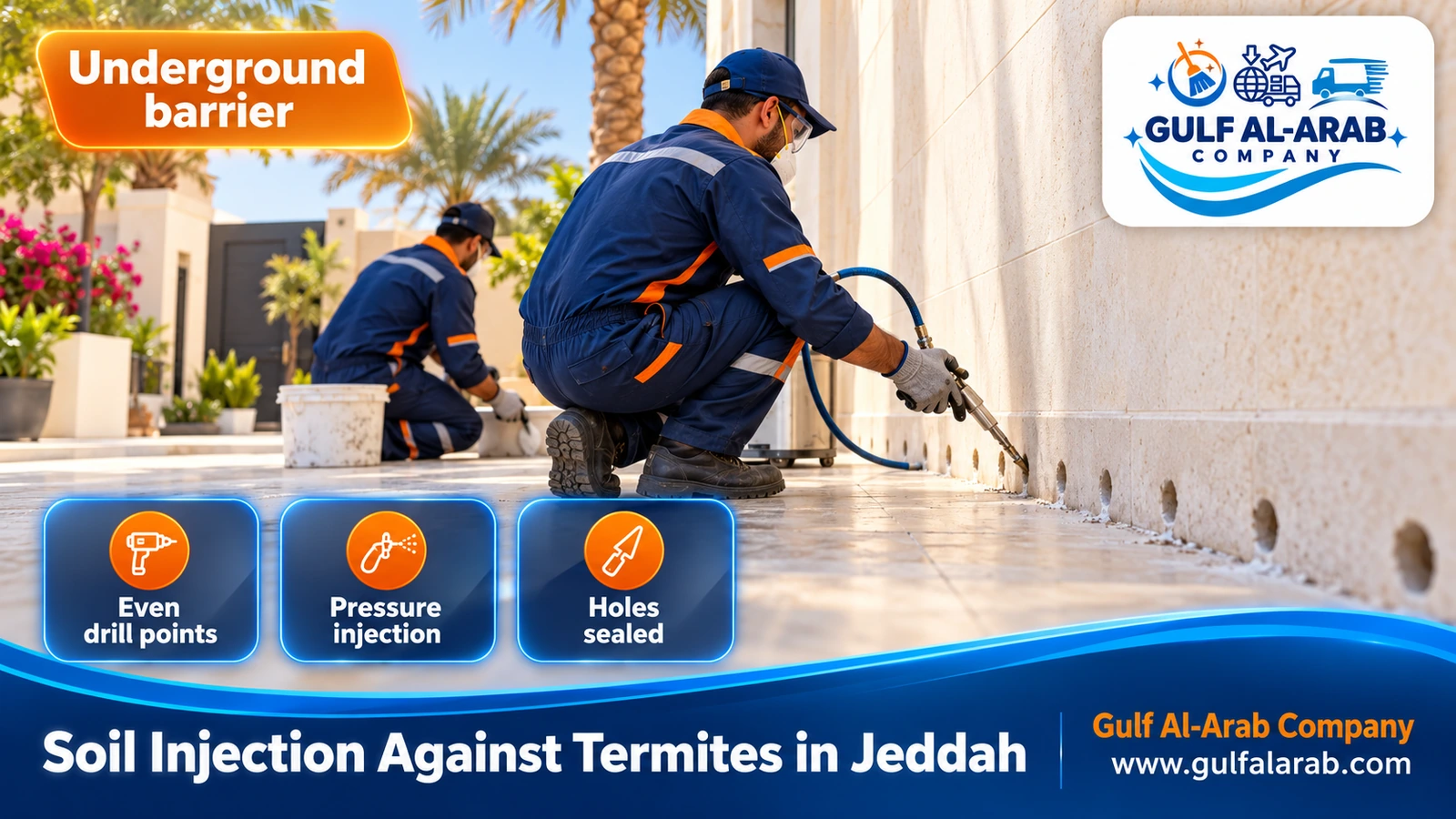
For soil injection we drill a row of small holes in the tiles along the wall at close intervals, then pump the termiticide solution beneath the tiles so it soaks into the soil and forms a continuous band. Each hole is then closed with filler or white cement close to the floor colour. We do not break or lift tiles; what you see afterwards is a neat line of small dots.
Spot treatment and door injection
For doors and frames we drill narrow holes in the jamb, starting low and spaced out, and inject the product inside the wood so it reaches the galleries the termites have dug. The holes are then filled with wood filler that can be painted to match the door. If part of the frame has already crumbled, the treatment stops further damage but cannot restore the wood, and we will tell you plainly when a piece needs a carpenter to replace it after treatment.
Does smoke or fumigation get rid of termites?
Whole-structure fumigation is used internationally for the dry-wood species in very specific cases; it means evacuating and tenting the building, and we do not consider it suitable for occupied homes in Jeddah. Household smoke bombs and aerosol cans do not reach inside the wood or the soil, so they do not solve the problem.
Found mud tubes or a hollow door?
Take a photo and send it on WhatsApp, or call us to book an inspection in your Jeddah district.
Call 0501533146 WhatsAppSteps of a termite control visit from start to finish
A termite visit with us follows six clear steps, from the inspection to written instructions sent on WhatsApp. The aim is that you know what was treated, why, and what to watch afterwards.
- Inspection: we tap doors and frames, measure moisture in the wood and wall, and trace the tubes back to their source.
- Finding the source: is the infestation rising from the soil or confined to a piece of wood? This decides the method and the price.
- Preparing the space: we ask you to clear clothes and belongings from wardrobes being treated and to cover nearby furniture.
- Treatment: drilling, injecting and sealing, or local injection of the wood, or fitting bait stations.
- Clean-up: we collect the drilling dust and wipe down the work area before leaving.
- Instructions and follow-up: we send you what to do over the next days and agree a check-up visit to confirm activity has stopped.
Most flats are finished in one to two hours, while a villa that needs a full soil barrier can take most of the day. You do not need to leave home for days, but children and pets should stay out of treated rooms until the product has dried and the room has been well ventilated — usually two to four hours, depending on the product and the airflow.
Protecting wooden furniture and built-in wardrobes from termites
Wooden furniture is protected by treating the parts that touch the floor and the wall — above all the bases of built-in wardrobes, the legs of wooden sofas and the backs of kitchen cabinets. Wardrobes fixed to the wall are the most at risk because they connect directly to the termites’ route, and people often discover an infestation when the clothes or papers on the bottom shelf turn dusty or chewed.
Before treatment we ask you to move the wardrobe contents onto a covered bed or table. We then treat the back base and lower sides by brush or injection and leave the doors open while the product dries. If you have furniture you are about to move to a new home, have it checked before the move so you do not take the infestation with you.

Kitchen cabinets
Their backs sit against the sink pipes, so we check and treat the base and ask for any leak to be fixed.
Parquet and wooden floors
We check the edges at the walls and thresholds and may lift a skirting board to see the route.
False ceilings
Timber framing above gypsum is checked wherever there is an AC leak or a damp stain.
Pergolas and outdoor seating
Posts set in the soil are treated at the base and lifted onto footings where possible.
Pre-construction termite treatment of the ground
Pre-construction treatment means spraying the soil with a termiticide after it has been levelled and compacted, and before the plastic sheet is laid and the concrete poured, so a barrier exists under the whole building from day one. It is the most economical way to protect a house in the long run, because reaching the soil once the tiles are down means drilling.
We usually work with the owner or the contractor in three stages: spraying the footing and ground-beam trenches, then spraying the soil under the ground slab after compaction, then spraying the backfill against the outside of the walls. We make sure the pour happens the same day or the next, and that the soil is not heavily watered after spraying. We also remind the contractor to remove leftover timber formwork from under the slab, because it is the first thing a colony heads for.

Instructions before and after termite treatment
Before the visit, the key points are to empty the affected wardrobes, move rugs away from the walls that will be injected, and not to break the mud tubes. After the visit, the most important thing is not to wash the injected strip of floor with lots of water in the first days, and to stop watering the garden right against the wall.
| Before the visit | After the visit |
|---|---|
| Take clothes and papers out of the affected wardrobes | Keep the room ventilated until the product is completely dry |
| Move rugs and sofas half a metre away from the wall to be injected | Do not wash the drilled tiles with lots of water for a few days |
| Do not break or spray the mud tubes | Do not put cardboard and timber back directly on the floor |
| Cover fish tanks and move birds out of the work rooms | Watch the old tubes: if they dry out and crumble, activity has stopped |
| Make sure we can reach the tank room and the garden | Photograph any new tube and send it on WhatsApp |
Mistakes that bring termites back after treatment
Termites usually come back because the source of moisture was left as it was, or because the treatment was a surface spray on the visible wood. The colony in the soil may be some distance from the house, and unless its route is cut it will find a new one.
- Spraying household aerosols on the tubes, so the colony moves to another wall.
- Replacing the infested door without treating the soil beneath it, so the new door is attacked within months.
- Leaving a tank or bathroom leak unrepaired after treatment.
- Putting cardboard boxes back on the storeroom floor against the wall.
- Relying on vinegar and salt — they may kill what they touch but never reach the queen or the soil.
If you also have cockroaches in the bathrooms or signs of rodents in the storeroom, it is more economical to deal with them in the same visit — see cockroach control in Jeddah and rodent control in Jeddah, or the full pest control company in Jeddah page for the other pests.
Tips to keep termites out of Jeddah homes
Termite prevention rests on one rule: keep moisture and wood away from the soil. As long as the foundation stays dry and no timber touches the ground, the chance of a colony getting in drops sharply.
Leave a dry strip
Keep a half-metre band of gravel or paving around the villa wall with no watering.
Fix leaks
The underground tank, the bathrooms and any AC dripping on the wall are the first line of protection.
Raise your storage
Keep cardboard and timber on metal shelving away from the floor and the wall.
Inspect yearly
A yearly walk-round of the lower doors and built-in wardrobes catches an infestation before it grows.
Jeddah districts we cover for termite control
We reach most districts of Jeddah from north to south, with particular focus on villas and new buildings in the north, where pre-construction treatment is common, and on older homes in the centre, where door and ceiling infestations are frequent.
| Area | Some of its districts | What we see most |
|---|---|---|
| North Jeddah and Obhur | Obhur Al-Shamaliyah, Obhur Al-Janubiyah, Al-Shati, Al-Muhammadiyah, Al-Naeem, Al-Basateen | Villas, gardens, new buildings and pre-construction work |
| Central Jeddah | Al-Rawdah, Al-Zahra, Al-Salamah, Al-Khalidiyah, Al-Hamra, Al-Andalus | Doors, built-in wardrobes and false ceilings |
| East Jeddah | Al-Safa, Al-Marwah, Al-Faisaliyah, Al-Samer, Al-Ajwad, Al-Hamdaniyah | Flats, duplexes and ground floors with small gardens |
| South Jeddah and Al-Balad | Al-Balad, Al-Kandarah, Al-Aziziyah, Al-Ruwais, Al-Nuzlah | Older buildings, warehouses and shops |
For warehouses, offices and shops we can schedule the work outside business hours if you need. If you do not see your district here, ask on WhatsApp — the list gives examples, it is not complete.
Book a termite inspection now
Call or WhatsApp 0501533146 and tell us your district and the type of property (flat, villa, or building under construction).
Call 0501533146 WhatsAppFor business enquiries or written contact you can also use our contact page.