
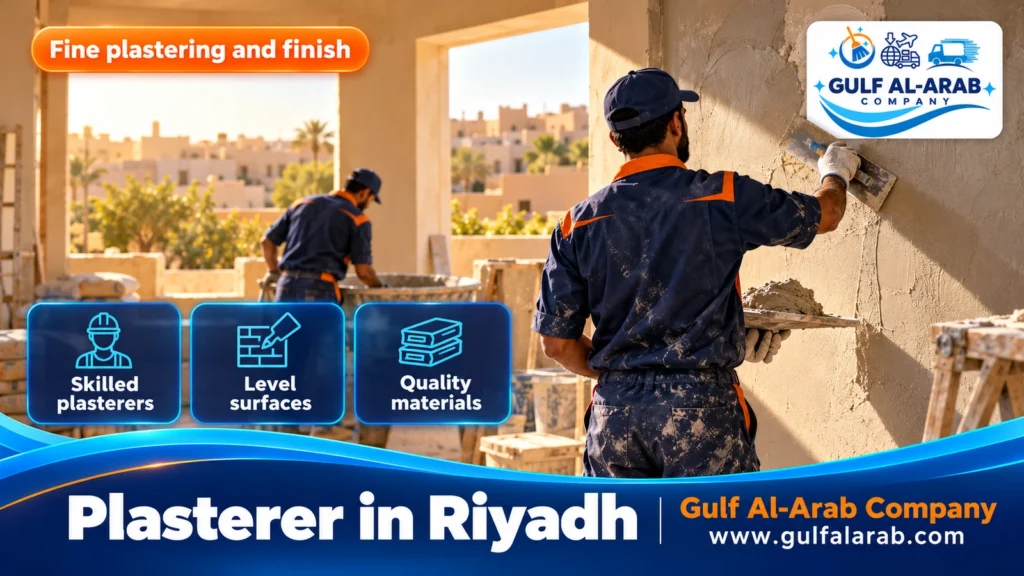
A plasterer in Riyadh from Gulf Al-Arab Company carries out interior wall plastering, ceiling plastering, straight corners and angles with metal corner beads, exterior façade plastering in standard or coloured render, and repair of cracked and blown plaster in villas, apartments, buildings and istirahas. Interior plastering with materials starts from SAR 13 per square metre, labour only starts from SAR 6.5 per metre, and exterior façades with materials start from SAR 18 per metre.
At a glance: plasterer in Riyadh
- Interior plastering with materials: starts from SAR 13 per m².
- Interior plastering, labour only: starts from SAR 6.5 per m².
- Ceiling plastering: starts from SAR 14 per m².
- Façade plastering with materials: starts from SAR 18 per m².
- Plastering with fibreglass mesh against cracks: starts from SAR 20 per m².
- Crack repair for one room: starts from SAR 140.
- Booking: via the contact page, with an inspection and measurement first.
Need a plasterer in Riyadh?
Write your district, the job and the approximate area on the contact page and we will arrange the plasterer’s inspection.
Request the serviceWhat is plastering and when does a home need it?
Plastering, known locally as liyasa, tilyees or mahara, is a layer of cement, sand and water spread over block and concrete walls to make them level, smooth and protected, ready for filler and paint or for tiles. In Saudi Arabia the tradesman who does it is called the mulayyis or plastering master.
A home needs plastering in three situations: in new construction once the blockwork, electrical conduits and plumbing are finished; during renovation when old plaster flakes, blows or cracks; and during alterations such as opening a new door, closing a window or building a partition. In every case the goal is the same: a straight, solid surface that neither cracks nor comes away from the wall.
Plaster is more than cosmetic. It protects blockwork from moisture and dust, covers conduits and pipes and gives the wall extra resistance to heat, which matters in a city like Riyadh where the weather swings between very hot summers and cold winter nights.
Plasterer services in Riyadh
Gulf Al-Arab plasterers handle all interior and exterior plastering, preparing the wall before work and curing it afterwards:
Interior wall plastering
Rooms, halls, majlis, corridors and stairs, finished level and ready for filler.
Ceiling plastering
Concrete ceilings after a spatter coat, from fixed scaffolding.
Corners and angles
Metal beads on external corners and straight edges around doors and windows.
Exterior façades
Salt-resistant cement, coloured render, or a base for stone and paint.
Crack repair
Removing loose plaster, fixing mesh and re-plastering.
Kitchens and bathrooms
Moisture-tolerant plaster under tiles or water-resistant paint.
Plastering new apartments and villas
In a new build the plasterer starts after the electrician and plumber have finished their runs and the door and window frames are fixed. He checks the walls first: is the blockwork straight, are the conduits buried deep enough, are there gaps between blocks and columns? These are fixed before he starts, because plaster does not correct major building errors; it only hides them for a while.
Smooth plaster ready for paint
Smooth plaster is a fine final coat that leaves the wall surface sleek, so less filler is needed before painting and the paint looks better and cleans more easily. It starts from SAR 17 per metre and suits majlis rooms, halls and bedrooms where owners care about the final surface.
Coloured render and white cement
Coloured render is mostly used on façades and villa boundary walls. It gives a lasting colour without paint and comes in smooth, textured or sprayed finishes. Coloured render with materials starts from SAR 20 per metre, and the owner chooses colour and texture from samples before work begins. White cement is used on some façades and decorative features for a clean, light surface.
Kitchen and bathroom plastering
Kitchen and bathroom walls face steam and water, so the plaster must be solid and keyed if tiles go on top, so the adhesive grips well, or smooth and cured if it will take moisture-resistant paint. Kitchen and bathroom plastering starts from SAR 19 per metre.
Removing old plaster before repair
When old plaster is blown, hollow behind or saturated with damp, there is no point putting a new coat over it, because it will fall away with the old one. The plasterer breaks out the weak layer down to sound blockwork, bags the debris and takes it to the collection point, then cleans and dampens the wall before the spatter coat. Removing old plaster starts from SAR 7.5 per metre.
Boundary walls, annexes and istirahas
Villa boundary walls, istiraha walls and outdoor annexes are sometimes exposed to sun on both sides and to spray when plants are watered, so they need a strong exterior mix and thorough water curing. On boundary walls we pay attention to the top and edges, since that is where water gets in first if they are not sealed well.
Plasterer prices in Riyadh
Plastering prices in Riyadh start from SAR 6.5 per square metre for labour only on interior walls and SAR 13 per metre with materials, rising for ceilings, façades, coloured render and repair work. These are the starting prices for each type:
| Service | Details | Starts from (SAR) |
|---|---|---|
| Interior plastering, labour only | Materials supplied by the owner | 6.5 per m² |
| Interior plastering with materials | Cement, sand, spatter coat and labour | 13 per m² |
| Exterior plastering, labour only | Façades and boundary walls | 14 per m² |
| Exterior plastering with materials | Resistant cement, sand and labour | 18 per m² |
| Ceiling plastering | Concrete ceiling with scaffolding | 14 per m² |
| Smooth plaster ready for paint | Fine finishing coat | 17 per m² |
| Plastering with fibreglass mesh | Mesh over the whole surface against cracking | 20 per m² |
| Coloured render with materials | Colour and texture from samples | 20 per m² |
| Kitchen and bathroom plastering | Under tiles or water-resistant paint | 19 per m² |
| Full villa plastering | Interior and exterior by area | 17 per m² |
| Removing old plaster | Breaking out and moving debris to the collection point | 7.5 per m² |
| Plaster rehabilitation for old buildings | Removal, mesh and re-plastering | 23 per m² |
| Crack repair for a room | Opening, meshing and re-plastering the cracks | 140 per room |
| Urgent repair visit | Patching a limited area | 185 per visit |
| Metal corner beads and engineered angles | By number and length of corners | Ask about the price at inspection |
The final cost depends on the actual area after deducting openings, wall height, the condition of the blockwork and whether the wall needs mesh or treatment before plastering. The plasterer measures the area at the inspection and writes down the scope and price before starting.
How to estimate the cost of plastering your home
Work out each wall’s area by multiplying its length by its height, add the walls together, subtract doors and windows, and add the ceiling if it will be plastered. If the walls of a three-bedroom flat with a hall total about 400 square metres, interior plastering with materials starts from around SAR 5,200, rising if fibreglass mesh, smooth plaster or ceilings are added.
- Area: large jobs such as a full villa have a lower cost per metre than a single room.
- Height: tall walls and double-height halls need scaffolding and more time.
- Wall condition: crooked blockwork needs a thicker coat and more material.
- Finish: standard is cheaper than smooth, and smooth is cheaper than coloured.
- Repairs: removing old plaster and clearing its debris is priced separately.
Wall plastering in Riyadh: the correct steps
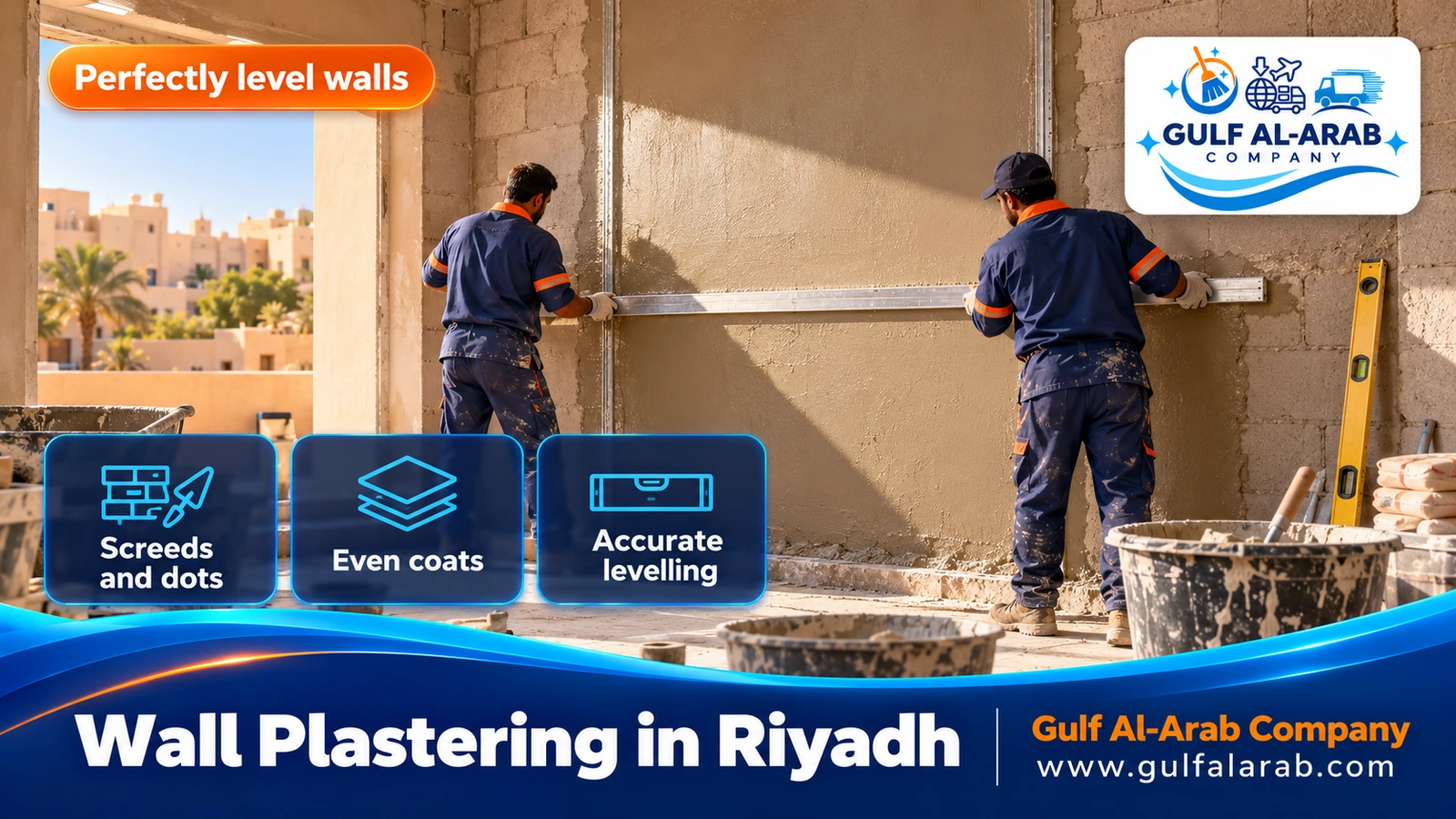
Good plastering follows fixed steps with nothing skipped: preparing the wall, the spatter coat, setting dots and screeds, spreading and levelling the coat with a straightedge, then curing with water. Each step affects the next.
- Clean and dampen the wall: remove dust and concrete residue, then wet the blocks so they do not suck water out of the mix too fast.
- Fix the mesh: a strip of metal or fibreglass mesh where blocks meet columns and beams and over buried conduits.
- Spatter coat: throw a thin, coarse cement mix onto the wall to give the plaster a surface to grip.
- Dots and screeds: spots and strips of mortar set with a plumb line to fix the level the coat is ruled to.
- Spread the coat: fill between the screeds with mortar and rule it off with an aluminium straightedge until level.
- Float the surface: rub it with a trowel or wooden float once it has firmed up to get the required texture.
- Cure: spray the wall with water for several days so the cement hardens without cracking.
Interior wall plastering with materials starts from SAR 13 per metre and includes all these steps except full-surface mesh, which is added when needed.
Plaster mix components and thickness
The table below shows the components of each coat and its usual thickness on ordinary walls; the plasterer adjusts them to the wall’s condition and location:
| Coat | Components | Usual thickness |
|---|---|---|
| Spatter coat | Cement, coarse sand and water at a runny consistency | A thin rough layer |
| Dots and screeds | The same mortar as the plaster | Set the final thickness |
| Interior base coat | Cement, washed sand and water | About 1.5 to 2 cm |
| Exterior coat | Salt-resistant cement and washed sand | About 2 to 2.5 cm |
| Smooth coat | Fine sieved sand and cement | A few millimetres |
| Coloured render | Ready coloured mix with water | Per manufacturer’s instructions |
Tip: Ask for the sand to be washed and free of clay. Dirty sand weakens the plaster and causes hairline cracks that appear after painting.
Ceiling plastering in Riyadh
Plastering a ceiling is harder than a wall, because the plasterer works overhead and the mix fights gravity. It needs a good spatter coat on the smooth concrete, fixed scaffolding to stand on safely, and a thinner coat than on walls so it does not get heavy and come away. Ceiling plastering starts from SAR 14 per metre.
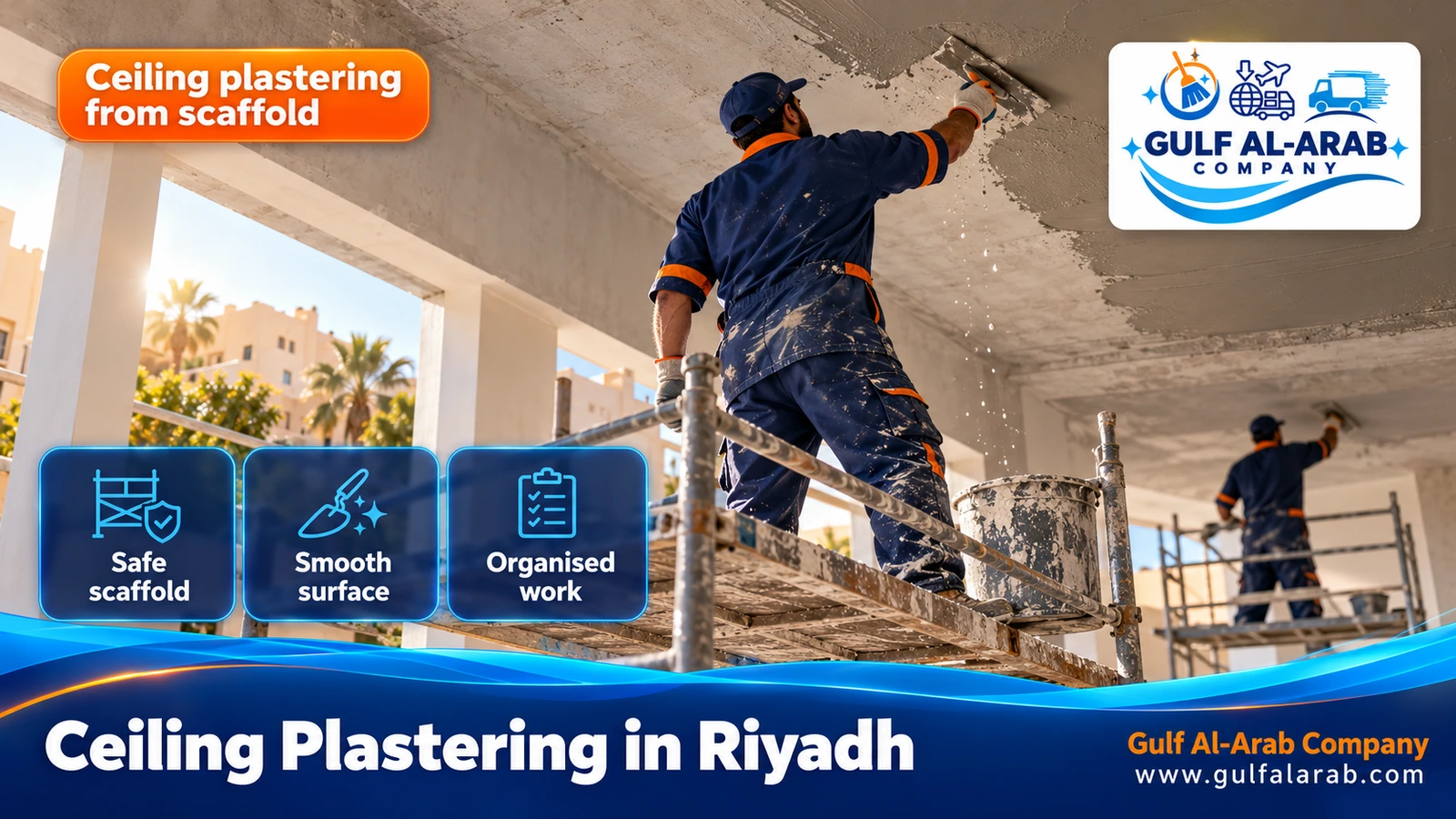
Before plastering a ceiling, the plasterer checks that the electrician has fixed the light boxes at the right level and that AC and spotlight conduits are in place, because changing them after plastering means breaking out and patching. If the ceiling will be covered by a suspended gypsum board ceiling, it may not need full plastering and sometimes only the visible edges are treated; the plasterer decides this at the inspection so you do not pay for work nobody will see.
Warning: A ceiling showing damp patches or rusting steel must have the cause treated before plastering, otherwise the new coat will come away and drop in pieces after a while.
Corner beads and angles in plastering
Corners and angles are the first thing the eye notices in a room and the first thing to chip when furniture moves. Getting them right means every corner is square and straight from floor to ceiling, with external corners protected by perforated metal beads buried in the plaster.
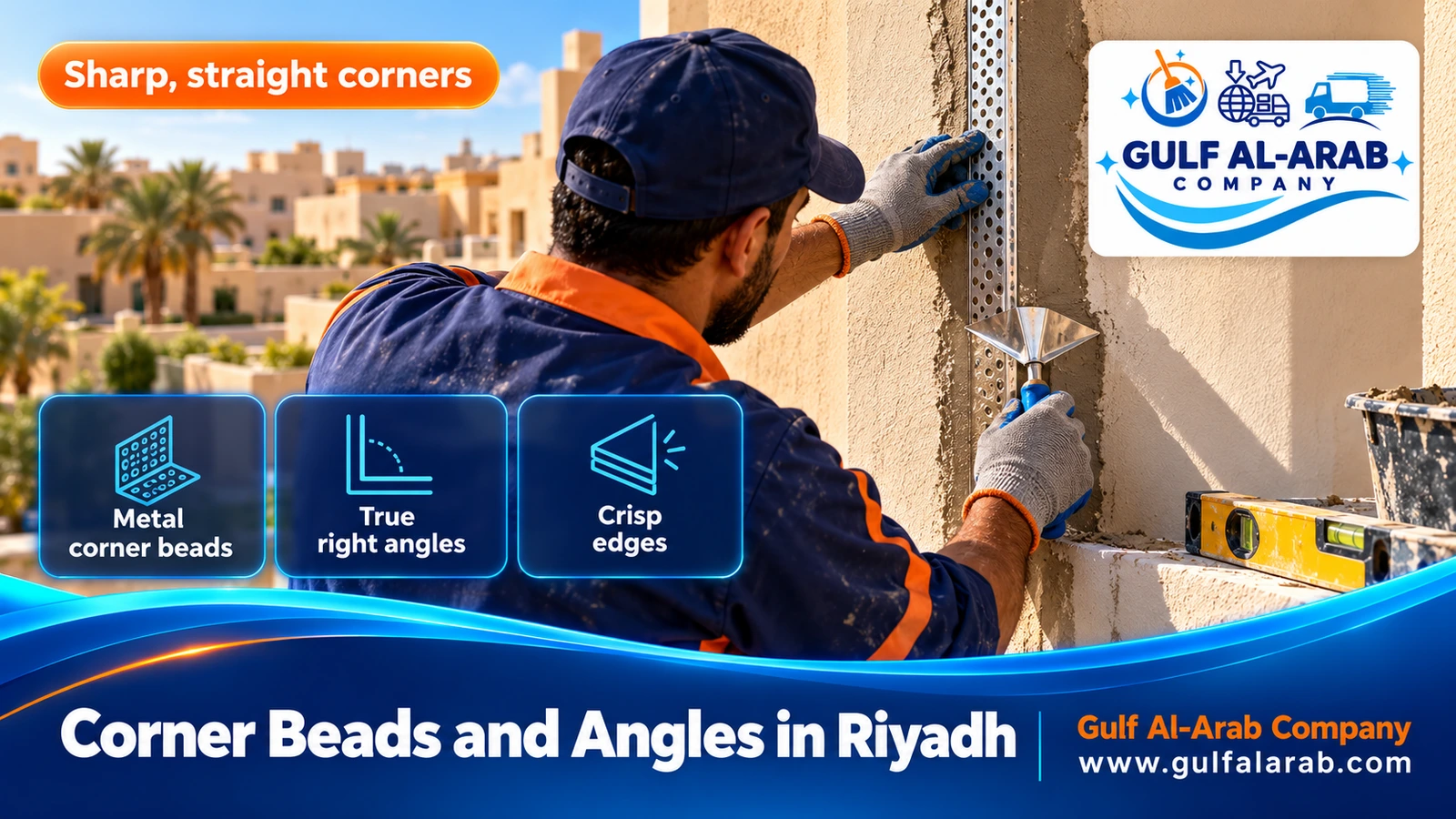
The plasterer sets the metal bead in mortar on the corner after levelling it, then plasters both sides until its edge disappears under the coat. Around doors and windows he rules the edges with a temporary timber or aluminium straightedge so they come out straight and square to the frame. In internal corners between two walls he uses a corner trowel for a clean line. The price of metal beads and engineered angles depends on the number and length of corners, so ask about it at inspection.
A good plasterer also takes care where the plaster meets floors, tiles and suspended ceilings, leaving the right gap for skirting and no broken edges that will need patching later.
Exterior plastering in Riyadh
Façade plastering faces direct sun, dust, wind and the gap between day and night temperatures, so it uses a stronger mix, salt-resistant cement, a slightly thicker coat than indoors and mesh at every joint between concrete and blockwork. Façade plastering with materials starts from SAR 18 per metre, and labour only from SAR 14 per metre.
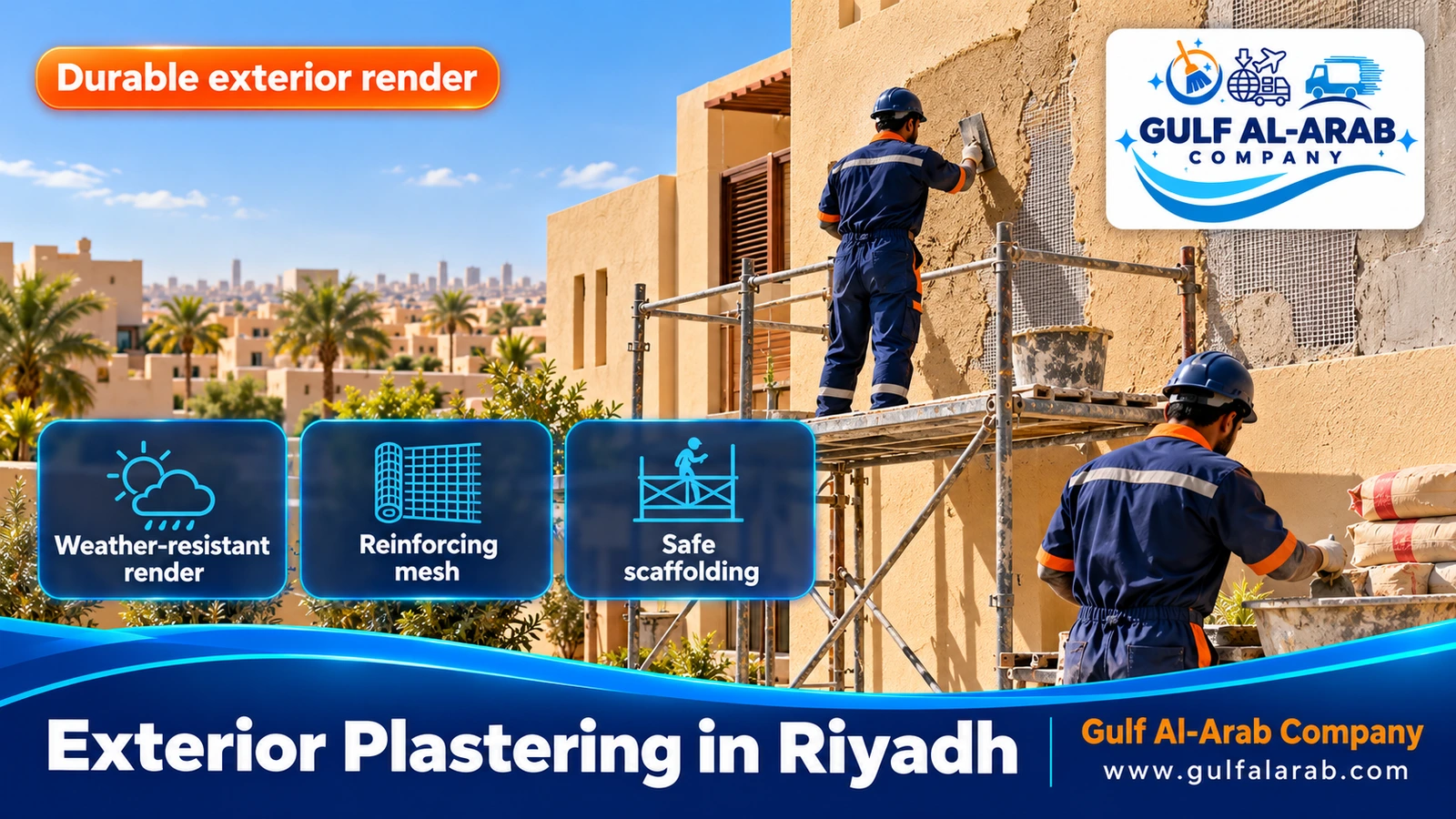
In summer, façade plastering is best done in the early morning or late afternoon, with freshly finished areas shaded from harsh sun or sprayed with water regularly, since fast drying is the biggest cause of cracks on Riyadh façades. Work is also avoided during dusty winds, which dry the surface and stick dirt to it.
Façade finish options
- Standard plaster under paint: the lowest cost, needing a weather-resistant exterior paint.
- Coloured render: colour built into the coat, in smooth, textured or sprayed finish.
- Plaster under stone: a keyed surface that helps stone adhesive grip.
- Fully meshed plaster: for façades prone to cracking or buildings with earlier cracks.
Cracked plaster repair in Riyadh
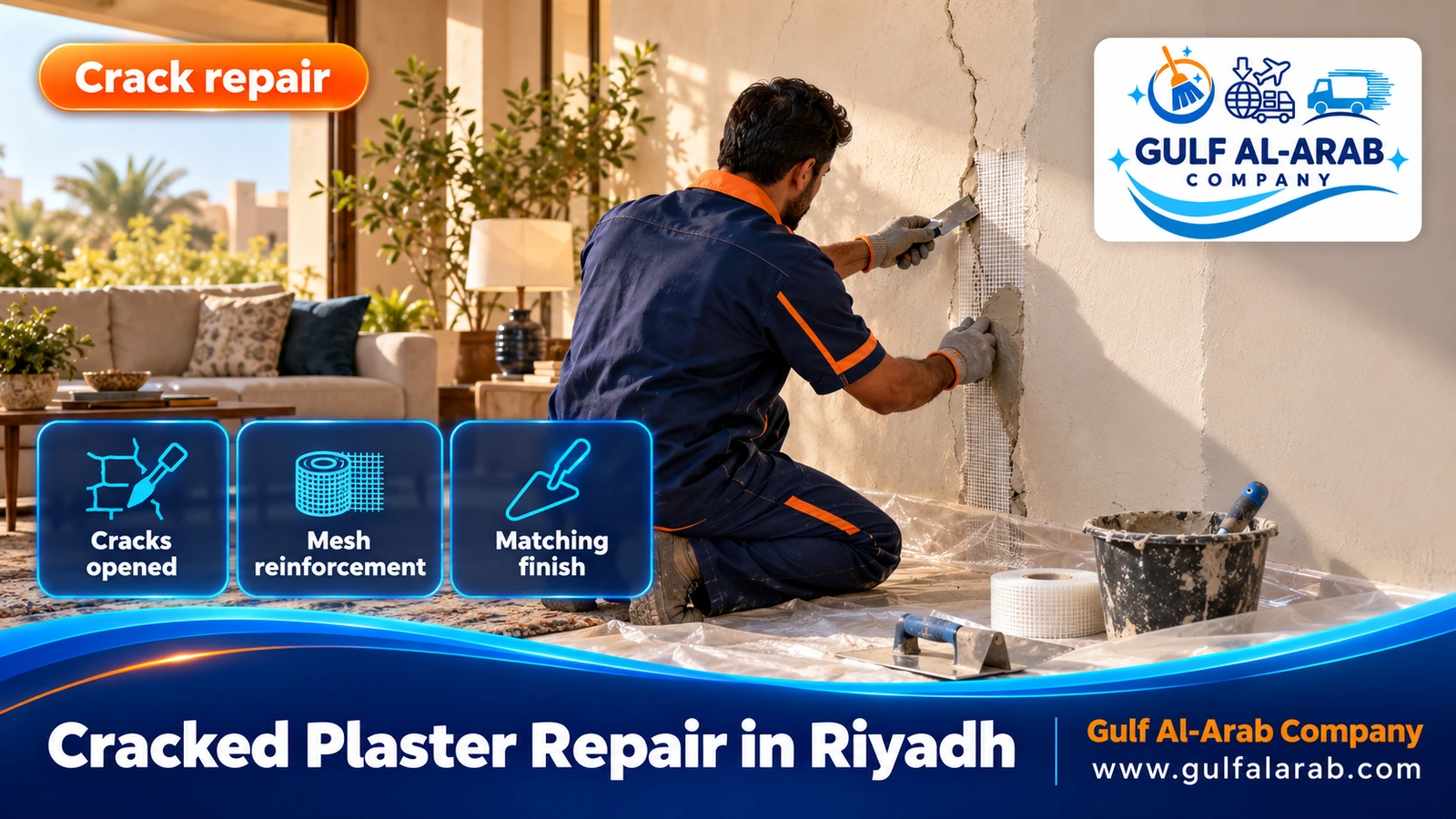
Repairing cracked plaster starts with identifying the type of crack and its cause, because a surface hairline crack differs from a deep crack running into the blockwork, and from blown plaster that has come away from the wall and sounds hollow when tapped. Crack repair for a room starts from SAR 140, and rehabilitation of old building plaster from SAR 23 per metre.
Why plaster cracks
- Fast drying without enough water spraying, especially in summer.
- No mesh where blockwork meets columns and beams.
- A mix too rich in cement or sand that was not washed.
- A very thick coat in one go to cover a crooked wall.
- Rising damp from the ground or a leak from a bathroom or tank.
- Foundation settlement or structural movement, which needs an engineer before any repair.
Steps for repairing cracks
- Find the detached areas by light tapping and mark them.
- Remove weak plaster down to a sound layer or to the blockwork.
- Open the cracks into a channel, clean out the dust and dampen them.
- Fix a fibreglass mesh strip over the crack with enough overlap on each side.
- Re-plaster in stages and level it with the surrounding surface.
- Cure with water, then prepare the surface for filler and paint.
Warning: If a crack runs diagonally from the corner of a window or door, or keeps widening, it may be structural. Get an engineer’s opinion before patching it, because plaster will not stop the movement.
How to inspect plastering before you accept it
Accepting plastering means checking it before filler and paint, because any defect that shows after painting becomes harder and more expensive to fix. These are checks you can do yourself:
Straightness
Hold a long aluminium straightedge on the wall in several directions; there should be no obvious gap beneath it.
Corners
External corners straight from floor to ceiling, internal corners crisp and clean.
Tap test
Tap the wall with a screwdriver handle; a hollow sound means detached plaster.
Surface
No obvious hairline cracks, no raised grains and no deep trowel marks.
Openings
Door and window edges straight and square to the frames.
Clean-up
Mortar residue removed from floors, frames and electrical boxes.
If you find a defect during the check, ask for it to be fixed straight away before the plasterer leaves; soft mortar is easier to adjust than hard.
The difference between plaster, gypsum board and filler
Many people confuse these three, although each has a different role. Plaster is a durable cement coat spread on blockwork and concrete to level and protect it, and it is the base for everything that follows. Gypsum board is ready-made panels fixed to a metal frame for suspended ceilings, light partitions or features, and it does not replace plaster on external walls or bathroom walls. Filler is a very thin layer applied over dry plaster to close small pores before painting.
So the quality of the plaster decides how much filler is needed afterwards: a straight, smooth wall needs a light coat of filler, while a crooked wall uses a lot and still shows its defect under side lighting. If you are planning a suspended gypsum ceiling in the halls, tell the plasterer at the inspection so he can decide which areas need full plastering and which will be hidden.
Where does plastering fit in the finishing sequence?
The correct finishing order in most homes is: blockwork, then electrical, plumbing and AC runs, then door and window frames, then interior and exterior plastering, then waterproofing in bathrooms and on roofs, then tiles and marble, then gypsum board, then filler and paint, then fitting electrical and sanitary fittings and doors. Moving any stage before or after plastering means breaking out and patching later, which is why the plasterer asks about the house’s stages at the inspection before setting a start date.
Plastering by the metre or by the day?
Pricing by the metre suits most jobs, because it ties the price to the area completed and the owner knows the cost before work begins. Day-rate work can suit small scattered jobs, such as patching several spots after the plumber or electrician or closing a few openings, because their area is hard to measure. The plasterer advises you at the inspection on the better option for your job.
Warning: Be wary of a very low price per metre that cannot cover good materials and enough time. It often comes with the spatter coat, mesh or water curing left out, so cracks appear months later and you pay for the repair.
Riyadh districts our plasterers serve
We serve residential districts across north, central, east, west and south Riyadh, including:
North Riyadh
Al Malqa, Al Yasmin, Al Narjis, Hittin, Al Arid, Al Sahafa, Al Nakheel, Al Ghadir.
Central and east Riyadh
Al Olaya, Al Sulaimaniyah, King Fahd, Al Wurud, Al Rawdah, Al Naseem, Al Rimal, Qurtubah, Al Khaleej.
West and south Riyadh
Al Suwaidi, Dhahrat Laban, Tuwaiq, Al Shifa, Al Aziziyah, Al Manfuhah, Al Nadheem, Al Taawun.
If your district is not listed, write it on the contact page; most of the newer plans on the edges of Riyadh are within our coverage.
Tips before plastering your Riyadh home
These tips save a lot of repair work later:
- Do not start plastering before the electrician and plumber finish and the water pipes are pressure-tested.
- Fix door and window frames before plastering so the edges can be ruled to them.
- Make sure there is mesh at every junction between concrete and blockwork.
- Keep spraying the walls with water morning and evening in summer after plastering.
- Do not paint straight away; let the plaster dry well for several weeks before filler and paint.
- Keep a small amount of the same sand and cement for any later patch with a matching colour.
Tip: Ask the plasterer to start with a small wall in a side room and check the result with a straightedge before he does the whole house; that way you agree on the finish standard from the start.
Why choose a Gulf Al-Arab plasterer in Riyadh?
Because we do not cut the steps that protect your wall: the spatter coat, the mesh, the dots and screeds and the water curing. And because the plasterer measures the area with you, writes down the scope before starting and cleans up when he finishes.
Clear price per metre
Interior plastering with materials starts from SAR 13 per metre after measuring.
Complete steps
Spatter coat, mesh, screeds and curing, with no step dropped to save time.
Clean-up after work
Mortar removed from floors, frames and boxes.
Once plastering and painting are done, if you are moving your furniture into the new home you can book a pickup furniture moving service in Riyadh. See our other services on the services page, or request an inspection from the contact page.
Article tags
Plasterer in Riyadh Plastering master Riyadh Plastering Riyadh Wall plastering Riyadh Ceiling plastering Riyadh Façade plastering Riyadh Exterior plastering Riyadh Coloured render Riyadh Smooth plaster Riyadh Fibreglass mesh plastering Plaster repair Riyadh Wall crack repair Riyadh Corner beads plastering Plastering price per metre Riyadh Plastering contractor Riyadh Plasterer north Riyadh Plasterer Al Malqa Plasterer Al Narjis Villa plastering Riyadh Gulf Al-Arab Company