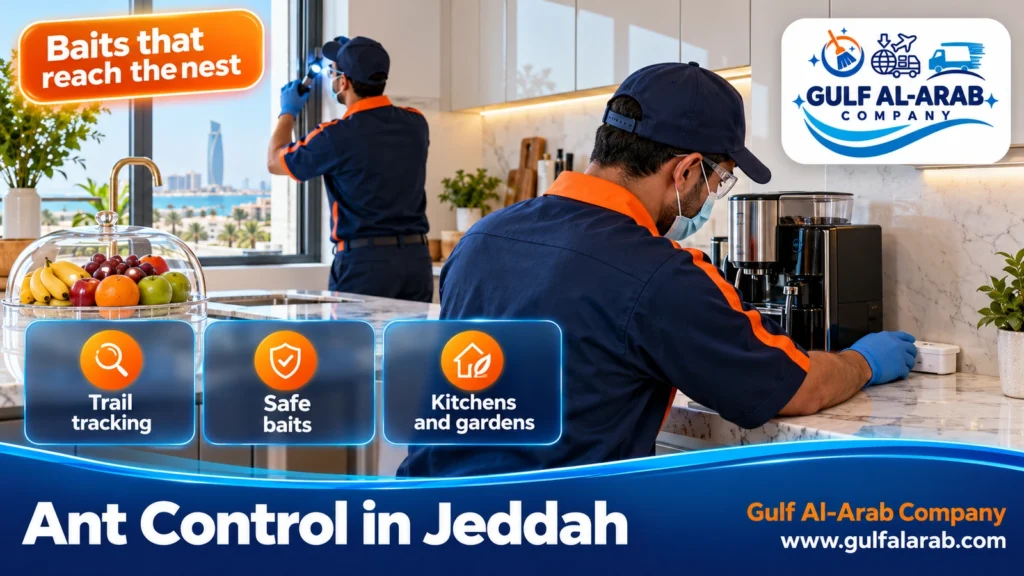
Ant control in Jeddah at Gulf Al-Arab Company does not start with spraying. It starts by following the ant trail until we know where the ants get in and where the nest is. We then place gel or granular baits inside small sealed stations that the worker ants carry back to the queen themselves. We treat kitchens, pantries, bedrooms, gardens and yards, and handle samsum ants with particular care. Treating a flat starts from SAR 185, a villa from SAR 420, and you can book by phone or WhatsApp on 0501533146.
Ant treatment in Jeddah at a glance
- Method: Trace the trail, then baits that reach the nest, with spot outdoor treatment where needed
- Flat treatment: From SAR 185 for the kitchen, bathrooms and rooms
- Villa with garden and yard: From SAR 420 inside and out
- When you see results: Ants drop within days and usually disappear within one to two weeks
- Samsum ants: Dedicated nest treatment in gardens — ask for the price
- Children and pets: Baits sit inside sealed stations, out of reach
- Contact: Call or WhatsApp 0501533146
How much does ant control cost in Jeddah?
Ant control in Jeddah starts from SAR 185 for a flat, covering trail tracing in the kitchen, bathrooms and rooms and baiting the entry points. A villa with a garden, a yard and an annex starts from SAR 420, because the work extends outdoors where the nests usually are. The price difference comes from the number of bait points, the area of open ground and the type of ant — not from the amount of pesticide.
This table shows the starting price for the most common situations in Jeddah:
| Service | Details | From (SAR) |
|---|---|---|
| Ant treatment in a flat | Trail tracing and baits in the kitchen, bathrooms and around windows | 185 |
| Villa inside and out | Rooms, kitchen and pantry plus the garden, yard and side passages | 420 |
| Samsum ant nests | Locating nests in the soil and treating them, with instructions for the family | Ask for the price |
| Restaurants, cafés and sweet shops | A bait and follow-up programme that fits around opening hours | 325 |
| Follow-up visit | Replacing baits the ants have used up and checking the points | Set with the first visit |
Because a bait needs time to reach the nest, a price that looks low for a quick spray can cost you more when the ants come back two weeks later and you call again. Always ask about the method before the number: is it spraying or baiting, and does it include the garden?
Types of ants in Jeddah homes and how to recognise yours
Most of the ants people complain about in Jeddah are of three kinds: very small ants that appear on sugar and honey and live inside walls, fast black ants that run around erratically and come in from the garden, and shiny black samsum ants that sting. Knowing the type matters, because a bait one species loves may be ignored by another — some prefer sugars, others lean towards protein and fats.
| Type | How to recognise it | Where it is common | Suitable bait |
|---|---|---|---|
| Small pale ant (pharaoh ant) | Very small, yellowish to light brown, long thin trails | Kitchens, bathrooms and electrical outlets inside flats | Slow-acting gel baits — spraying makes them spread |
| Fast black ant | Grey-black with long legs, runs in a random pattern | Balconies, gardens and around planters | Sugar baits plus outdoor treatment |
| Ghost ant | Dark head and an almost see-through abdomen, barely visible | Around sinks and plant pots | Sugar baits at several points |
| Large black ant | Bigger, usually seen at night | Gardens and damp wood | Treating the outdoor nests |
| Samsum ant | Shiny black, medium-sized, walks alone and stings | Soil, lawns, under stones and paving | Careful treatment of the nest in the soil |
If the insect is pale and comes out of wood or mud tunnels, it is none of these — it is a termite, and the treatment is completely different; read about it in termite control in Jeddah.
Where do ants get into the house? Trace the trail first
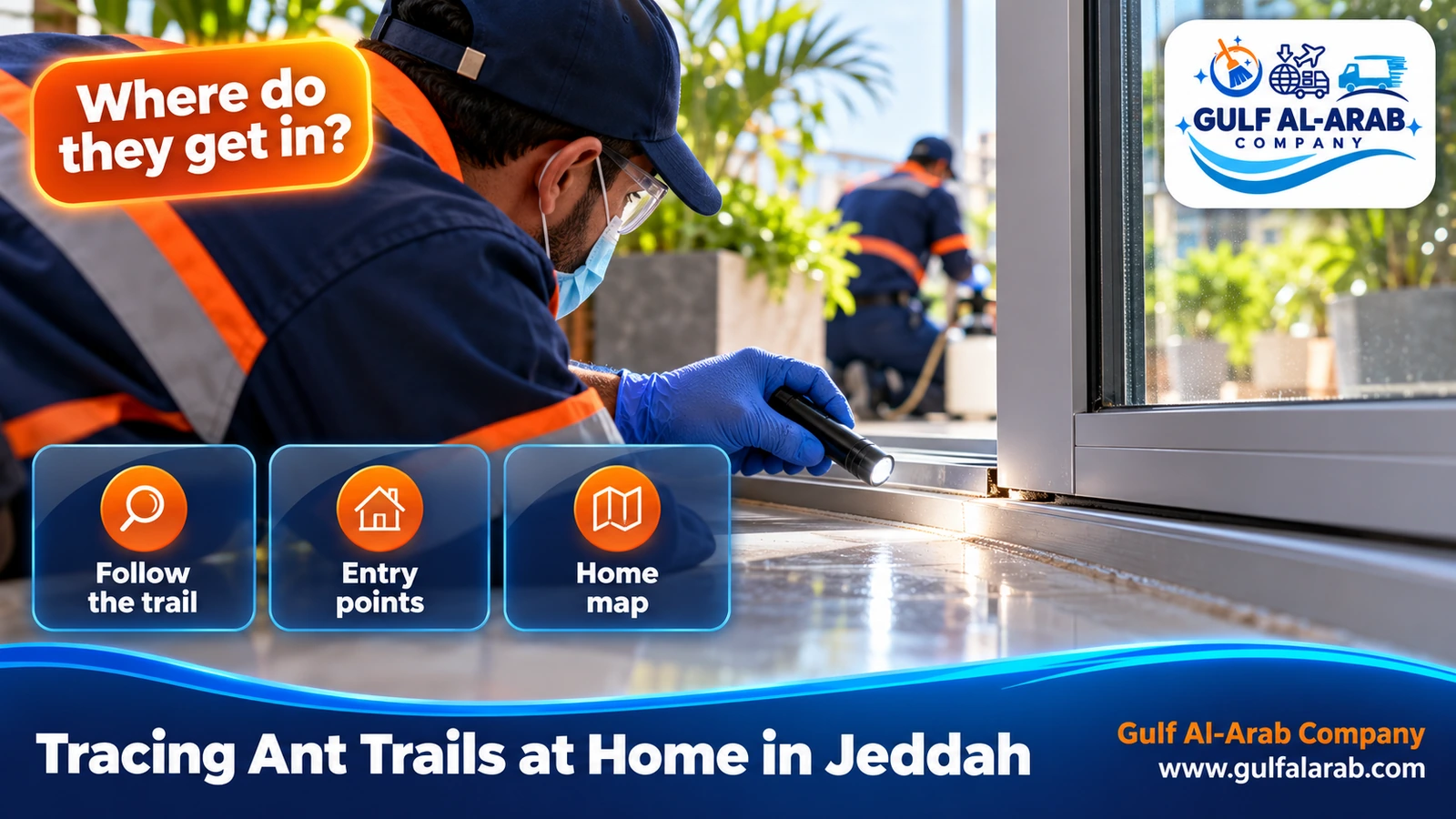
Ants get in through gaps far smaller than you would imagine: a joint in the sill of an aluminium balcony door, an opening around the AC pipe, a power socket in a wall next to the garden, or a crack between the marble and a kitchen cabinet. That is why the visit begins with following the trail with a torch from the food source until it disappears into the wall or under the sill, and drawing a simple map of the home’s entry points.
This step is the difference between a treatment that lasts and one that fails. Bait placed in the middle of the kitchen is eaten only by the ants you see, while bait placed on the trail near the entry point is picked up by worker ants on their way and carried to the nest.
Balcony and window sills
Gaps in aluminium channels are the first route for ants coming from pots and plants.
Pipe openings
Around the sink, AC and washing-machine pipes, where the silicone seal is weakest.
Power sockets
Small ants live in wall cavities and come out around sockets and switches.
Tile and marble joints
Especially between the kitchen worktop and the wall and at cabinet bases.
Why do ants come back after spraying?
Ants come back after spraying because the insecticide kills only the visible workers; nothing reaches the queen and the eggs in the nest, so the colony replaces its losses within days. Worse still, with the small pale ant a disruptive spray can push the colony to split into smaller nests in new places, so a problem that was only in the kitchen ends up in three rooms.
That is why indoors we rely on baits: food the ants like mixed with a slow-acting insecticide. A worker eats it and lives long enough to return to the nest and feed it to the queen and larvae. That slowness is the secret of success, which is why we ask you not to spray the trail after the bait goes down, even if you see ants crowding round it — the crowding means it is working.
| Comparison | Conventional indoor spraying | Baits in stations |
|---|---|---|
| What it kills | The ants visible at the moment of spraying | Workers, then the queen and larvae through the nest |
| Smell and ventilation | An odour and a room cleared for hours | Odourless, no need to leave home |
| Effect on the colony | Can split it into new nests | Weakens it from the inside until it collapses |
| When results show | Immediately, then the ants usually return | Within days, with a steady drop over two weeks |
| Children and pets | Sprayed surfaces they can touch | Sealed stations in places out of reach |
Safe ant baits around children: how we place them
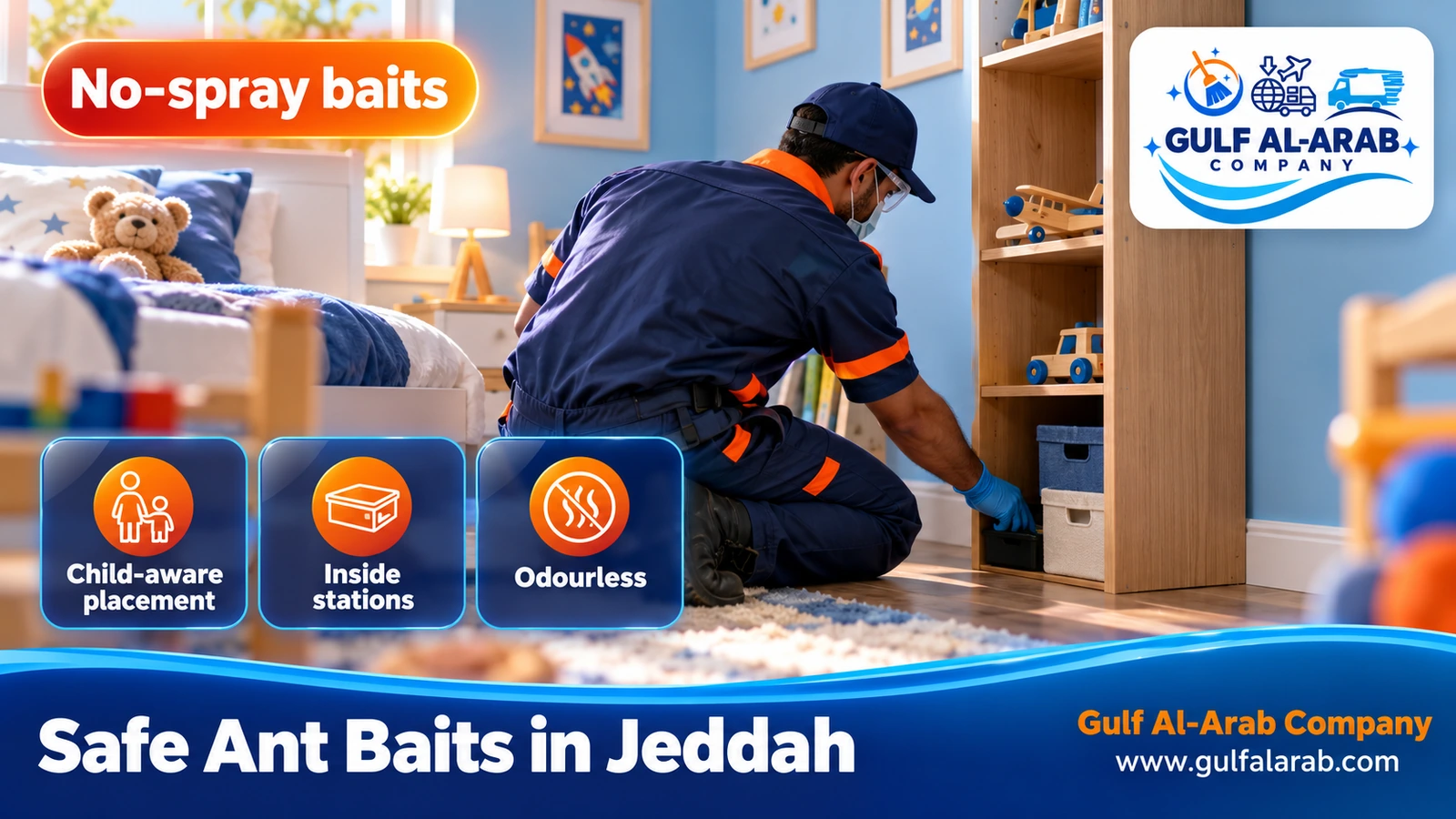
We place ant baits inside small sealed plastic stations with openings only ants can enter, and fix them behind appliances, under cabinet edges and behind the bases of tall shelves — places a child’s hand or a cat’s mouth cannot reach. In narrow cracks we use gel bait in very small dots inside the crack itself.
We use products registered with the competent authorities and intended for household use, and we tell you how many stations there are and where, so you do not move or throw them away while cleaning. We never say any product is absolutely safe; safety comes from the small quantity, the sealed station and keeping it out of reach.
Ant control in gardens and yards
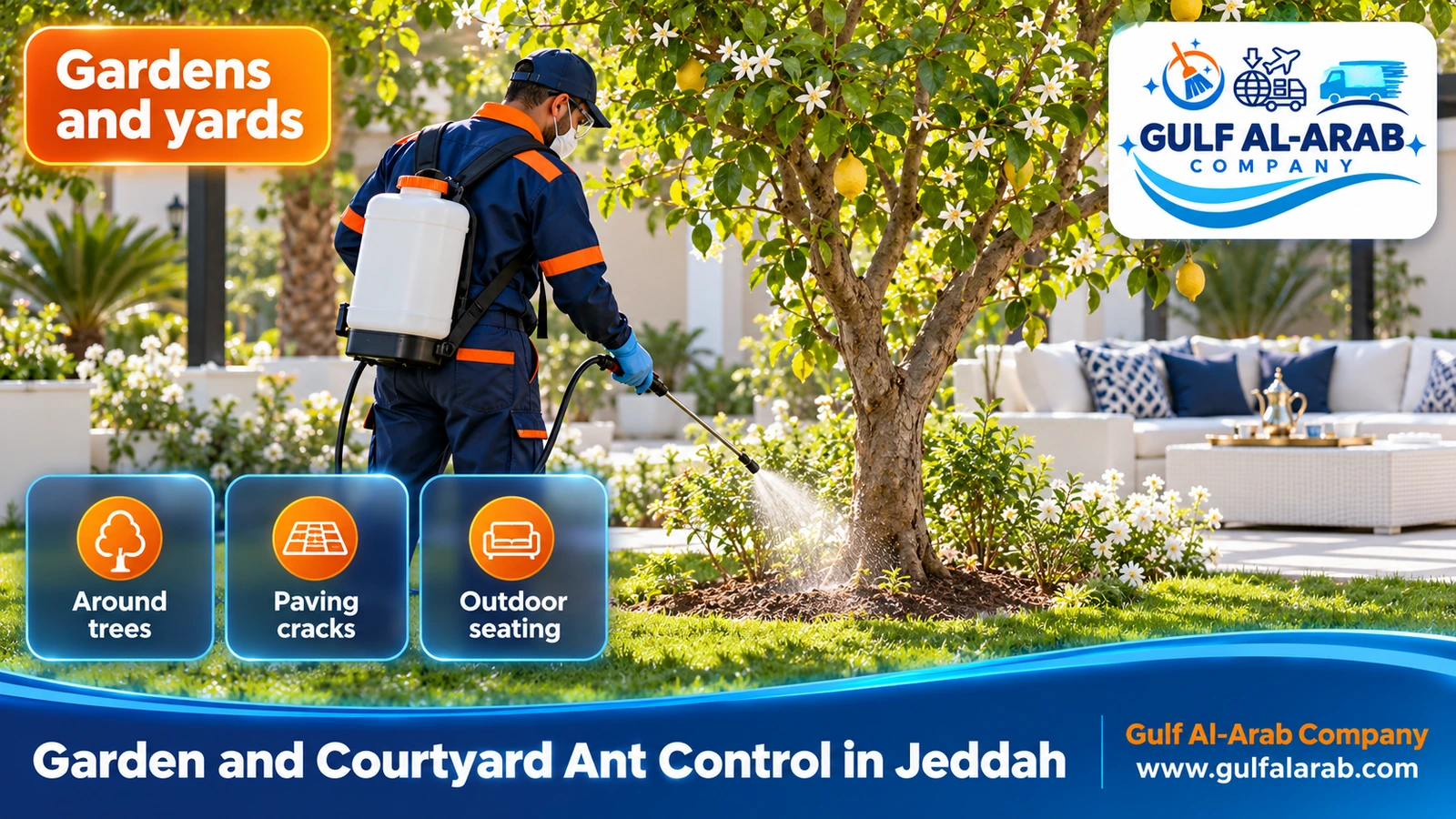
Ants in gardens and yards are treated at the source. We look for nest openings in the soil, around tree trunks and between cracked paving, treat them directly with a product suited to soil, and apply a spot band around the base of the house to cut off the way in. In Jeddah nests are common around lemon and guava trees and planters watered every day, and under paving that has lifted or cracked.
In the yard we take care around outdoor seating, swings and children’s play equipment: we do not spray them, and we treat the soil around them away from surfaces that get touched. If the garden has samsum ants, we locate the nests one by one and ask that children stay off the lawn until we come back to check.
- Reduce watering right against the wall — permanently damp soil is a favourite nesting spot.
- Raise plant pots on small stands and keep them away from the living-room door sill.
- Trim branches that touch the wall or windows; they are a direct bridge for ants.
- Fix lifted paving in the yard — the space beneath it is an ideal home for colonies.
Ants in the kitchen or the garden?
Photograph the trail or the nest and send it on WhatsApp so we can identify the type, or call to book a visit in your district.
Call 0501533146 WhatsAppProtecting the kitchen, pantry and food stores from ants
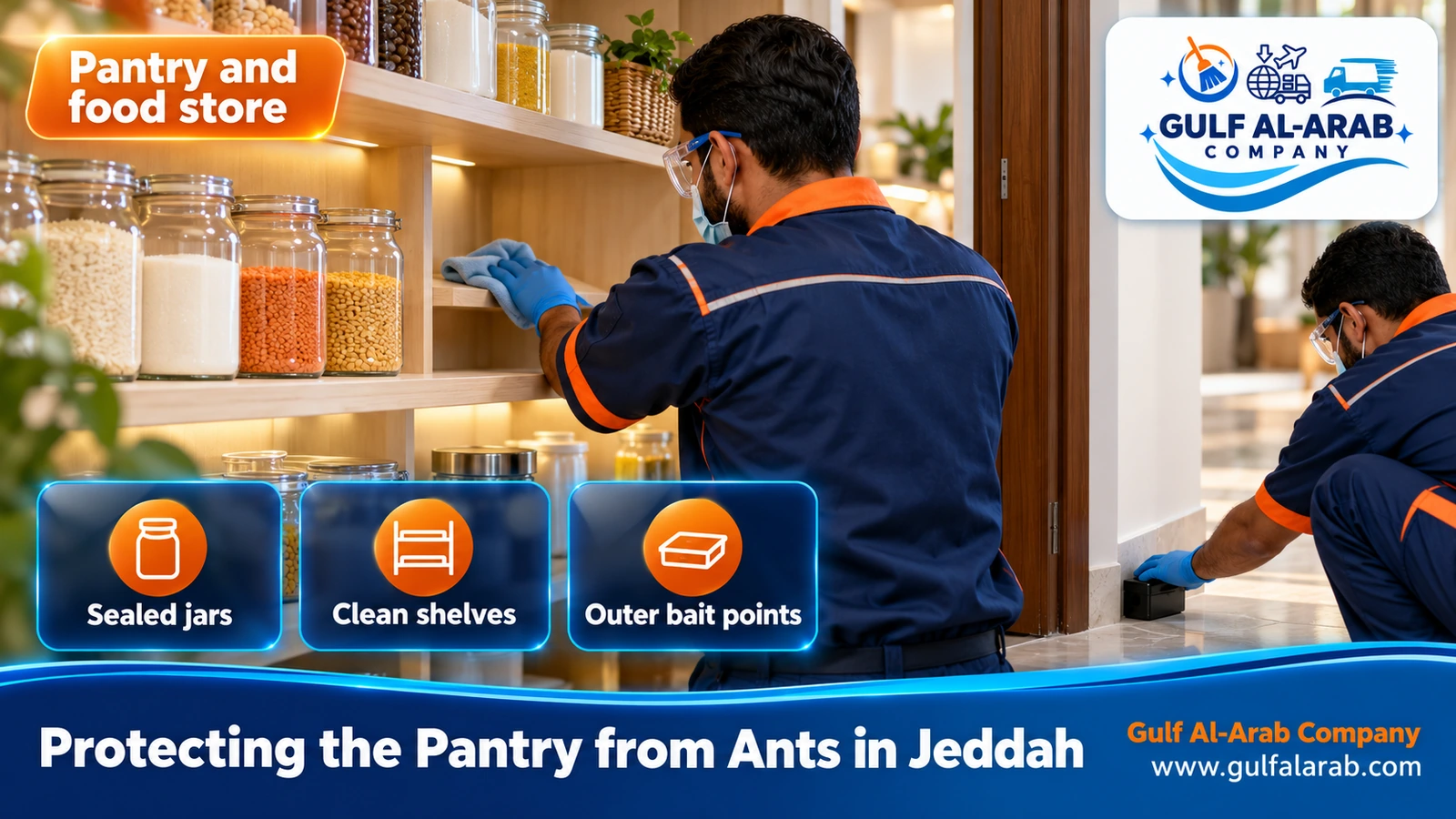
The kitchen and pantry are protected first by sealing the food: sugar, flour, dates and honey in airtight glass or plastic containers, shelves wiped free of crumbs, and a lidded bin emptied daily. Then our part is to place bait points on the trail outside the pantry and at the base of its door, so the ants pick up the bait before they reach the food.
In Jeddah homes that store dates and sugar in bulk for Ramadan or the seasons, we suggest moving the stores to a high shelf away from the wall and checking old containers, because small ants get through any loose lid. If you find ants inside a container, do not just throw it away; clean the shelf with soap and water to remove the scent trail the ants follow.
If you also have cockroaches coming out of the drains at night, their treatment is different and needs special gels and baits; you will find the details in cockroach control in Jeddah.
Steps of an ant control visit at home
An ant visit follows five steps. Most flats are done in under an hour, and villas with a garden in about two hours.
- Questions and identification: we ask where and when you see the ants and examine a sample to identify the type.
- Trail tracing: we follow the trails with a torch to the entry points and mark them on a simple map.
- Baiting: sealed stations and small gel dots on the trail, with the bait chosen to suit the species.
- Outdoor treatment: in villas we treat the nests in the soil and a band around the foundation.
- Instructions and follow-up: we explain what to do during the bait days and arrange a visit to replace used baits if needed.
After the visit you may see ants crowding round the stations for two or three days, which is normal. A clear drop starts within days, and the ants usually disappear within one to two weeks, depending on the size of the colony. If the trail continues after that, send us a photo and we will review the points.
How to prepare the home before the team arrives
Little preparation is needed, but three things make the visit quicker and more accurate: do not wipe the ant trail on the morning of the visit so we can see and follow it, empty the bottom shelf under the sink so the technician can reach the pipes, and gather any open food in one place. If you have a cat or birds, tell us beforehand so we place the stations away from where they eat and drink.
Home ant remedies: what helps and what hurts
Some home remedies genuinely help and some undermine the treatment. Whatever cuts off food and scent helps; whatever kills the visible ants quickly, before they carry the bait to the nest, hurts.
| Helps | Hurts or does nothing |
|---|---|
| Wiping the trail with soapy water or vinegar to remove the scent before the visit | Spraying aerosols on the trail after the baits are down |
| Keeping food in airtight containers and emptying the bin daily | Sprinkling powder everywhere, so the ants change route |
| Sealing gaps around pipes with silicone once the treatment is finished | Sealing the entry points before the bait works, trapping the nest inside the wall |
| Fixing leaks under the sink | Pouring hot water on samsum nests, which brings the ants out stinging |
When do you need an ant control company?
You need a company when ants persist for more than two weeks despite cleaning, appear in more than one room, come out of power sockets and walls, or when there are stinging ants in the garden and children in the house. In these cases the colony is large or split into several nests, and a single supermarket bait is not enough.
Ants in more than one room
A sign that the colony has split or that the nest is inside the wall.
Ants from sockets
They live in wall cavities and need precise bait placement in cracks.
Stings in the garden
Usually samsum ants, which need their nests located and treated.
Food shop or restaurant
Ants can cause trouble at a health inspection, so early treatment saves money.
Ants are also food for other creatures: lots of them around outdoor lights, together with other insects, draw geckos to the walls — see gecko control in Jeddah — while the other pests are covered on the full pest control company in Jeddah page.
Ants in apartment buildings: why do they come from the neighbours?
In apartment buildings small ants travel between flats through wall cavities, electrical conduits and shared drain pipes, so you can treat your flat well and still see ants return from next door a few weeks later. That is why, when more than one resident complains, we recommend treating neighbouring flats in the same week and including the tank room, the roof and the ground-floor entrance if it has plants.
Within a single flat we start where it connects to the shared pipes: behind the sink, under the bath, around the washing-machine drain and at the electrical box. We also ask whether the ants appear early in the morning or after sunset, because the timing helps us tell whether the nest is inside the wall or outside.
Neighbouring flats
Treating two or three adjoining flats together blocks the way back through shared walls.
Tank room and roof
Damp tanks and leaking float valves attract ants and give them a route to the floors below.
Building entrance
Planters at the entrance are the first stop for ants coming in from the street.
Building owners
A follow-up programme for the whole building costs less than separate call-outs for each flat.
Flying ants in the house: are they dangerous?
Flying ants indoors usually mean that a mature colony nearby has released new queens and males to found other nests, which typically happens on hot, humid days. The flying ants themselves do not sting or eat wood, but they are evidence of a large nest in the wall or the garden that needs treating.
Before you worry, check the wings: if the front wings are longer than the back ones and the waist is narrow, it is an ordinary ant; if the wings are roughly equal and the body has no waist, it is most likely a termite and the treatment differs. Collect a few in a clear bag or take a close-up photo and send it on WhatsApp so we can identify the type before the visit.
Jeddah districts we reach for ant treatment
We treat ants in flats, villas and restaurants across most of Jeddah. In the north we reach Al-Shati, Al-Naeem, Al-Muhammadiyah, Al-Basateen, Al-Yaqout and both parts of Obhur, where gardens and outdoor nests are common. In the centre we cover Al-Rawdah, Al-Zahra, Al-Salamah, Al-Khalidiyah, Al-Nahdah and Al-Andalus; in the east Al-Safa, Al-Marwah, Al-Samer, Al-Ajwad, Al-Hamdaniyah and Al-Rabwah; and in the south Al-Aziziyah, Al-Baghdadiyah, Al-Sharafiyah, Al-Kandarah and Al-Balad.
The problem changes with the character of the district: in apartment blocks small ants moving between flats through wall cavities are common, in villas garden ants and samsum ants dominate, and in the older markets and shops storeroom complaints are frequent.
Book ant treatment today
Call or WhatsApp 0501533146, tell us your district and where you see the ants, and send a photo if you can.
Call 0501533146 WhatsAppFor written contact or business requests, use our contact page.