
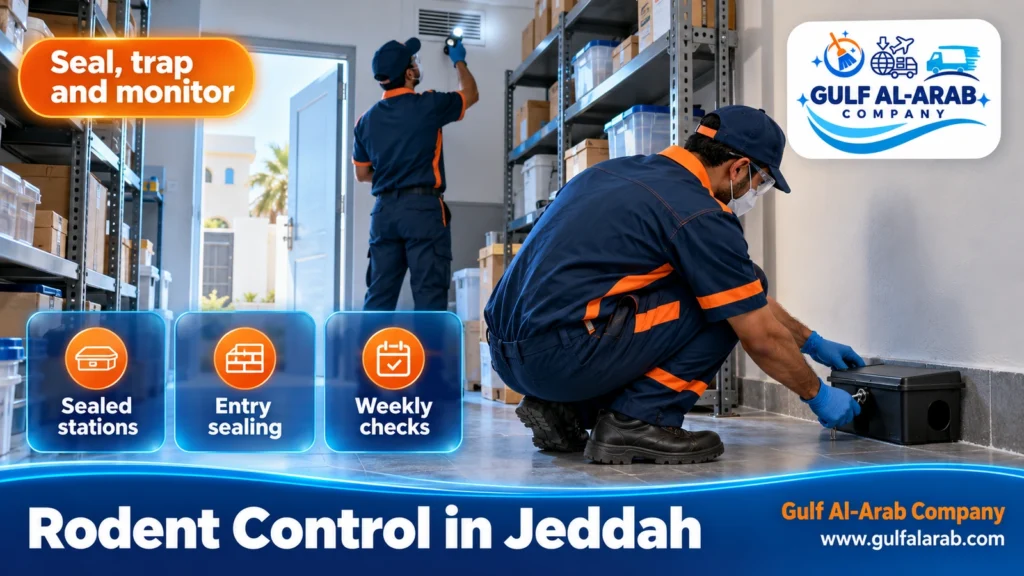
Rodent control in Jeddah at Gulf Al-Arab Company rests on four connected steps: we find out how the rodents get in, seal the gaps with materials they cannot gnaw, place key-locked bait stations and traps on their runways, and follow up until activity stops. We work in flats, villas, kitchens, restaurants and warehouses. A flat visit starts from SAR 168 and a villa station programme from SAR 278. Contact us by phone or WhatsApp on 0501533146.
Rodent control in Jeddah at a glance
- Flat visit: From SAR 168: inspection, traps and stations in the kitchen and storeroom
- Villa programme: From SAR 278 for locked stations around the boundary wall and annexes
- Restaurants and warehouses: From SAR 325, with a visit report
- Monthly contract: From SAR 184 per monthly visit for businesses
- Time to results: Activity drops within days; full control usually takes two to three weeks
- Safety: No loose bait — every bait sits inside a locked station
- Contact: Call or WhatsApp 0501533146
How much does rodent control cost in Jeddah?
Rodent control in Jeddah starts from SAR 168 for a flat visit, covering the inspection and the placing of traps and stations in the kitchen, the storeroom and wherever there is activity. Beyond that, the cost depends on how many stations are needed, whether the property needs entry points sealed with metal mesh, and how many follow-up visits it takes for activity to stop. A large rat coming up from the drains usually needs more work than a small mouse that slipped in through the kitchen door.
The table shows the starting point for each type of job:
| Service | Details | From (SAR) |
|---|---|---|
| Flat visit | Inspection, traps and locked bait stations in the kitchen, storeroom and runways | 168 |
| Villa station programme | Numbered stations around the boundary wall, annex and tank room, with follow-up | 278 |
| Restaurants and warehouses | A plan of stations, traps and gap sealing with a report for every visit | 325 |
| Monthly business contract | A monthly visit to check stations and record activity | 184 per visit |
| Entry sealing | Metal mesh, door sweeps, sealing around pipes and drain openings | Ask for the price |
Note that the lowest figure is not always the best value. A visit that drops poison in the corners and leaves may kill a mouse or two, but it leaves the way in open for others, and a rodent may die inside a wall or ceiling and leave a smell for days. Ask before you book: does the visit include sealing the entry points, and how many follow-ups?
How can you tell there are rodents at home before you see one?
Most people in Jeddah discover rodents from sounds or droppings before they ever see one, because rodents are active at night and travel tight against the walls. The clearest signs are small dark droppings shaped like a grain of rice near food, gnawed bags or boxes, scratching in the false ceiling after midnight, and dark greasy smears along the base of walls where their bodies rub.
Droppings
A mouse’s are about the size of a grain of rice; a rat’s are much larger and collect in particular spots.
Gnaw marks
Corners of cabinet doors, bags of rice and bread, cable insulation and plastic pipes.
Sounds
Scratching and running in false ceilings and AC ducts, especially after midnight.
Rub marks
Grey greasy lines on the wall at corners and around the openings they use.
Smell
A faint ammonia smell in the storeroom or under the kitchen when activity is ongoing.
Your cat’s behaviour
The household cat staring persistently at one wall or cabinet door.
Three rodents in Jeddah: which one do you have?
Three main kinds of rodent get into Jeddah homes, and each needs different trap positions and baits. The brown rat burrows in soil and lives near drains, the black rat is a climber that lives in ceilings, trees and palms, and the small house mouse lives inside the home itself, close to food.
| Type | Size and look | Where it lives | What works |
|---|---|---|---|
| Brown (Norway) rat | Large and heavy, tail shorter than the body, small ears | Inspection chambers, drains and burrows in the yard soil | Heavy ground stations, damp-resistant wax baits and sealing burrows |
| Black rat (roof rat) | Slimmer, tail longer than the body, a skilled climber | False ceilings, roofs, palms and trees touching the building | Traps and stations up high, and trimming branches |
| House mouse | Small, about finger-sized, large ears | Inside kitchens, cabinets and storerooms | Many small traps and closely spaced stations |
It helps to know that a young mouse can squeeze through a gap about the width of a pencil and a rat through one about the width of a thumb, so sealing only the big holes is not enough. Rats are also very wary of new objects on their route and may avoid a trap for two or three days before going near it — which is why treatment needs follow-up rather than a single visit.
Rodent proofing: the step many people skip
Sealing the entry points is what makes control last; however many rodents you kill, others replace them as long as the way in is open. We inspect the house from the outside first: drain openings at the foot of the boundary wall, the edges of the yard and outer kitchen doors, the openings for AC and gas pipes, and ventilation openings. Then we move inside to where pipes enter the wall under the sink and behind the washing machine.
We use fine metal mesh for openings that must stay open for ventilation or drainage, steel wool with a sealant for the gaps around pipes, and a rubber or metal sweep under doors whose gap is wider than a pencil. Expanding foam and silicone on their own are easily gnawed through.

- Rainwater drain openings at the bottom of the boundary wall: metal mesh fixed with screws.
- The gap under the outer kitchen door and the yard door: a door sweep.
- AC pipe openings into the wall: steel wool, then sealant.
- A broken or loose inspection-chamber cover: replaced or secured.
- Branches and palms touching the roof: trimmed back far enough to prevent jumping.
Locked bait stations: how we protect children and cats
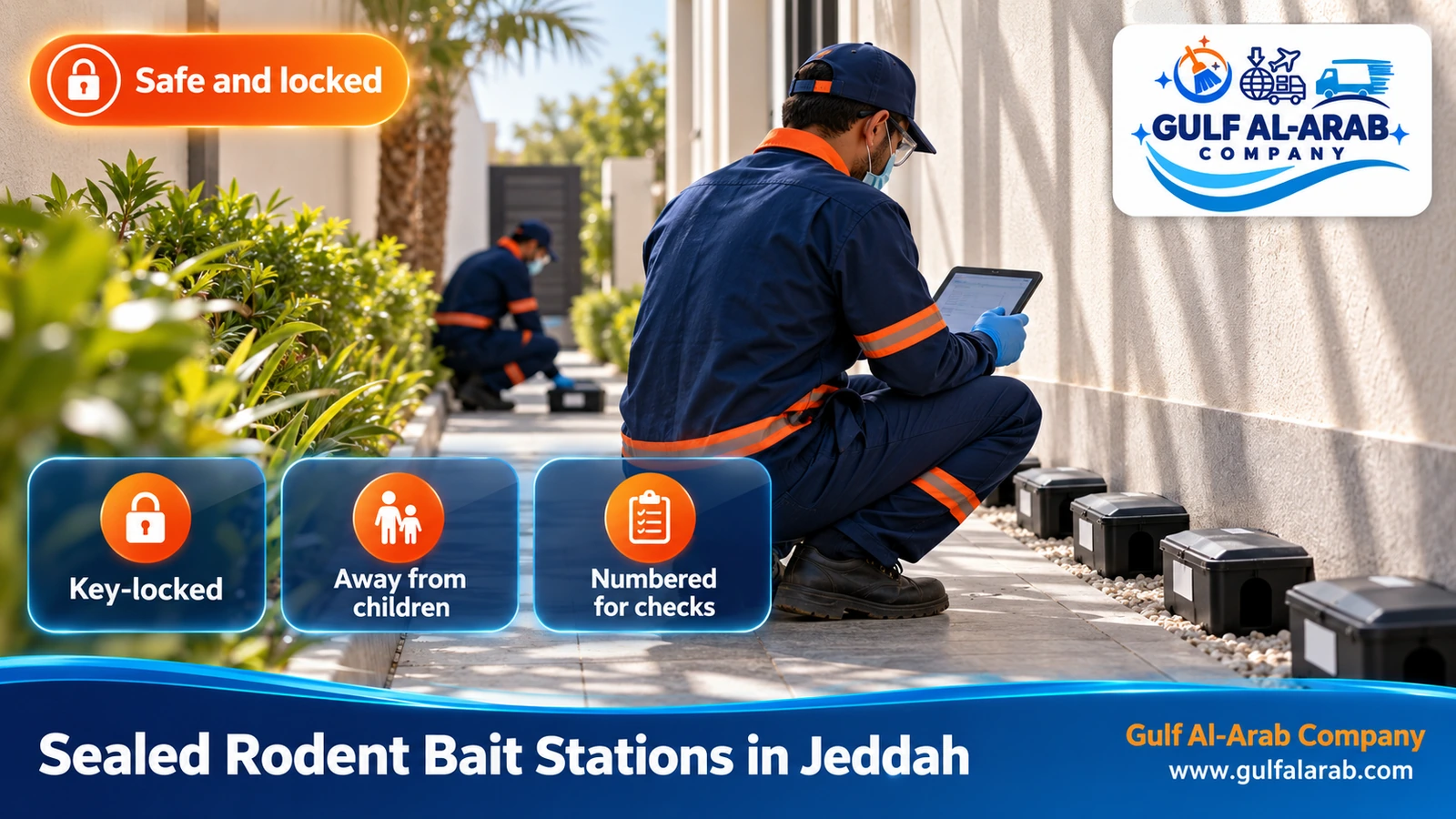
A bait station is a tough plastic box locked with a key, with two small openings that let rodents reach bait fixed on an internal rod. A child or a cat cannot get to it and the bait cannot spill on the floor. We fix stations along the walls on rodent runways, number them, and record at every visit how much was eaten from each one so we know where activity is concentrated.
The baits we use are registered with the competent authorities, and most work slowly over several days — deliberately, so the other rodents do not link the bait with danger. Even so, we never describe any rodenticide as safe, which is why we never put loose bait inside homes. If you suspect a child or pet has touched bait, call a doctor or vet immediately and keep the product label.
| Tool | Where we use it | Advantage | What to watch |
|---|---|---|---|
| Locked bait station | Around the boundary wall, passages and warehouses | Protects the bait from children and rain | Needs checking and bait replacement |
| Snap trap | Inside kitchens, storerooms and ceilings | No poison, and a result you can see | Set on the runway and checked daily |
| Glue board | Enclosed spaces and for monitoring | Shows whether rodents are present and how many | Never used alone, and checked constantly |
| Physical sealing | Every outside opening | Stops new entries | Done in stages once trapping has started |
Hearing scratching in the ceiling?
Send a photo of the droppings or gnaw marks on WhatsApp, or call to book an inspection in your district.
Call 0501533146 WhatsAppRodent control in kitchens and restaurants
In a kitchen, rodents hide behind the big appliances: behind the fridge where the motor gives off warmth, under the oven, behind the dishwasher, and in the space above the wall cabinets. So we pull the fridge out and check behind it with a torch, put snap traps in tight spaces a hand cannot reach, and seal the pipe openings behind the sink.
In restaurants and cafés the work is more careful, because any poison near food is effectively ruled out. Inside the kitchen we rely on snap traps and glue boards, and put the locked stations outside and at the storeroom and bin-area doors. After each visit we hand over a report of station locations and recorded activity, which is what a restaurant owner needs for a health inspection.

Daily hygiene
Do not leave dishes with food scraps overnight, and empty the bin before bed.
Sealed storage
Rice, flour and bread in hard containers, not in bags on the floor.
Extractor opening
Fit mesh over the outside extractor vent; the black rat climbs up to it.
Standing water
Fix the sink leak and dry the floor; rats need water every day.
Rodent control in warehouses and businesses
Warehouses need a plan, not a visit. We map the warehouse, place locked stations at regular intervals along the outer and inner walls and traps at the doors and loading areas, then visit monthly or more often depending on activity, recording the result for each station. This system protects stock from gnawing and contamination and gives management a clear record.
In Jeddah’s industrial area, rats often come in from open land and drainage channels, so we pay attention to loading doors that stay open for hours, suggest strip curtains or door sweeps, and ask for a gap between the pallets and the wall so inspection is easy. The monthly business contract starts from SAR 184 per visit.

Rodents in false ceilings and AC ducts
Rodents in a false ceiling give themselves away by running and scratching at night, dark marks on the gypsum boards, and droppings falling at light fittings or AC grilles. The culprit is usually the roof rat, which climbs from trees or palms touching the building onto the roof, then gets in through AC pipe openings or a gap around the rooftop water tank.
Treatment here starts from the top. We open the ceiling access hatch and check the void with a torch, set snap traps on the beams and pipes they run along, seal the entry points from the roof with metal mesh, and ask for nearby branches to be trimmed. We do not put poison in the ceiling, because a rodent may die above the room and be hard to remove; we prefer trapping, whose results can be checked day by day.
Steps of a rodent control visit
A rodent visit has five stages. It takes about an hour in a flat, and longer in a villa or restaurant depending on the number of entry points.
- Outside inspection: the boundary wall, drain openings, doors, roof and trees touching the building.
- Inside inspection: behind appliances, under sinks, the storeroom and the false ceiling, mapping runways from droppings and rub marks.
- Trapping and stations: traps inside the home and numbered locked stations outside and on the runways.
- Staged sealing: closing outside entry points with mesh, steel wool and door sweeps in stages.
- Follow-up: a visit to check traps and stations and replace bait, until there is no sign of activity for a full week.
How to prepare the home before we arrive
Do not clean up the droppings on the day of the visit so we can see where they are concentrated; empty the bottom shelf under the sink and the storeroom entrance; and leave a way through to the ceiling hatch, the tank room and the roof. If you have a cat, tell us so we can choose trap positions to suit, and do not put down any poison yourself before the visit, or the rodent may avoid the new traps.
The damage rodents do at home: why not wait?
Rodents are not just a nuisance. They contaminate food and surfaces with urine and droppings, carry well-known diseases such as leptospirosis and salmonella, gnaw electrical cables and raise the risk of short circuits and fire, and damage plastic pipes and insulation. The house mouse also breeds very quickly: pregnancy lasts about three weeks and a female can give birth many times a year, so one mouse becomes a big problem within a few months.
- Clean droppings with gloves and a mask, spraying disinfectant before wiping — never dry sweeping, which raises dust.
- Throw away any uncovered food that shows gnaw marks.
- Check appliance cables behind the fridge and washing machine once treatment is over.
Tips to stop rodents coming back after treatment
Two things stop rodents returning: they find no way in, and they find no food or water. If the treatment ends but the drain opening stays without mesh, or bags of rice stay on the storeroom floor, rodents from the neighbours or the street will find the house again.
Close the bins
Keep rubbish in a bin with a tight lid away from the kitchen door, and never leave bags on the ground overnight.
Watch the yard
Fill in and report any new burrow in the soil or under the paving straight away.
Bird and cat food
Do not leave it out all night; it is the biggest draw for rats in yards.
Regular checks
A quick monthly walk round the wall openings, doors and tank room catches problems early.
Common mistakes when getting rid of rodents yourself
The most common mistake is throwing poison pellets into corners: a child or cat reaches them, the rodent carries them off and stores them somewhere else, and it may die inside a wall or ceiling and leave a smell for days. Other mistakes are relying on a single trap, or putting the trap in the middle of the room, away from the wall the rodent runs along.
| Mistake | The right alternative |
|---|---|
| Loose poison in corners | Baits inside locked stations on the runway |
| One trap in the middle of the kitchen | Several traps set at right angles to the wall on the rodent’s route |
| Ultrasonic devices on their own | Sealing plus trapping — devices alone do not solve the problem |
| Sealing every gap on day one | Sealing in stages so no rodent is trapped inside |
| Stopping after the first catch | Following up until droppings and sounds stop for a full week |
If the kitchen also has cockroaches or ants, it is more economical to treat them together in one visit; read about cockroach control in Jeddah and ant control in Jeddah, and if geckos appear around the roof and lights, see gecko control in Jeddah. For other pests, go to the pest control company in Jeddah page.
What happens after a rodent control visit?
After the first visit, activity usually drops within days. We then come back to check the traps, replace used bait and complete the sealing. Full control in homes usually takes two to three weeks, and longer in large warehouses. We consider the problem solved when several days in a row pass with no fresh droppings, no eaten bait and no sounds.
If a bad smell appears after a few days, a rodent has most likely died somewhere hidden; send us the location of the smell and we will help find it. With ventilation the smell usually fades within days.
Jeddah districts we cover for rodent control
We reach homes, restaurants and warehouses across Jeddah for rodent control. Districts where we work often include Al-Balad, Al-Kandarah, Al-Hindawiyah and Al-Baghdadiyah, with their older buildings and markets; Al-Aziziyah, Al-Rehab, Al-Safa and Al-Marwah in the east; Al-Rawdah, Al-Salamah, Al-Zahra, Al-Nuzhah and Al-Faisaliyah in the centre; and Al-Shati, Al-Muhammadiyah, Al-Naeem, Al-Basateen and Obhur Al-Shamaliyah in the north, as well as warehouses in the Industrial Area and Al-Khumrah.
Each area has its own character: in the older districts, rats from the drains are common; in the north, roof rats climbing palms and trees onto roofs are more frequent; and in warehouses, stacked goods call for a station plan and monthly follow-up.
Book rodent control now
Call or WhatsApp 0501533146 and tell us your district, the type of property and where you see the signs.
Call 0501533146 WhatsAppFor contracts or formal correspondence, use our contact page.