

Need an electrician in Al-Naseem to connect a new water heater on a safe line, stop a breaker that trips every time the heater switches on, or work out whether your kitchen socket can really handle a new oven? Call or WhatsApp 0565564857. We take calls from Al-Naseem 24 hours a day and tell you the actual arrival time before you confirm.
Bathrooms and kitchens are where most of our call-outs in this district end up, because that is where water and heavy appliances meet. Our rule at Gulf Al-Arab is plain: every appliance that deserves its own line gets one, and anywhere with water gets leakage protection. Everything else we do in the city is on the home electrician in Makkah page.
What we fix in Al-Naseem homes
- Water heaters: new connections, element and thermostat checks, replacing burnt heater switches
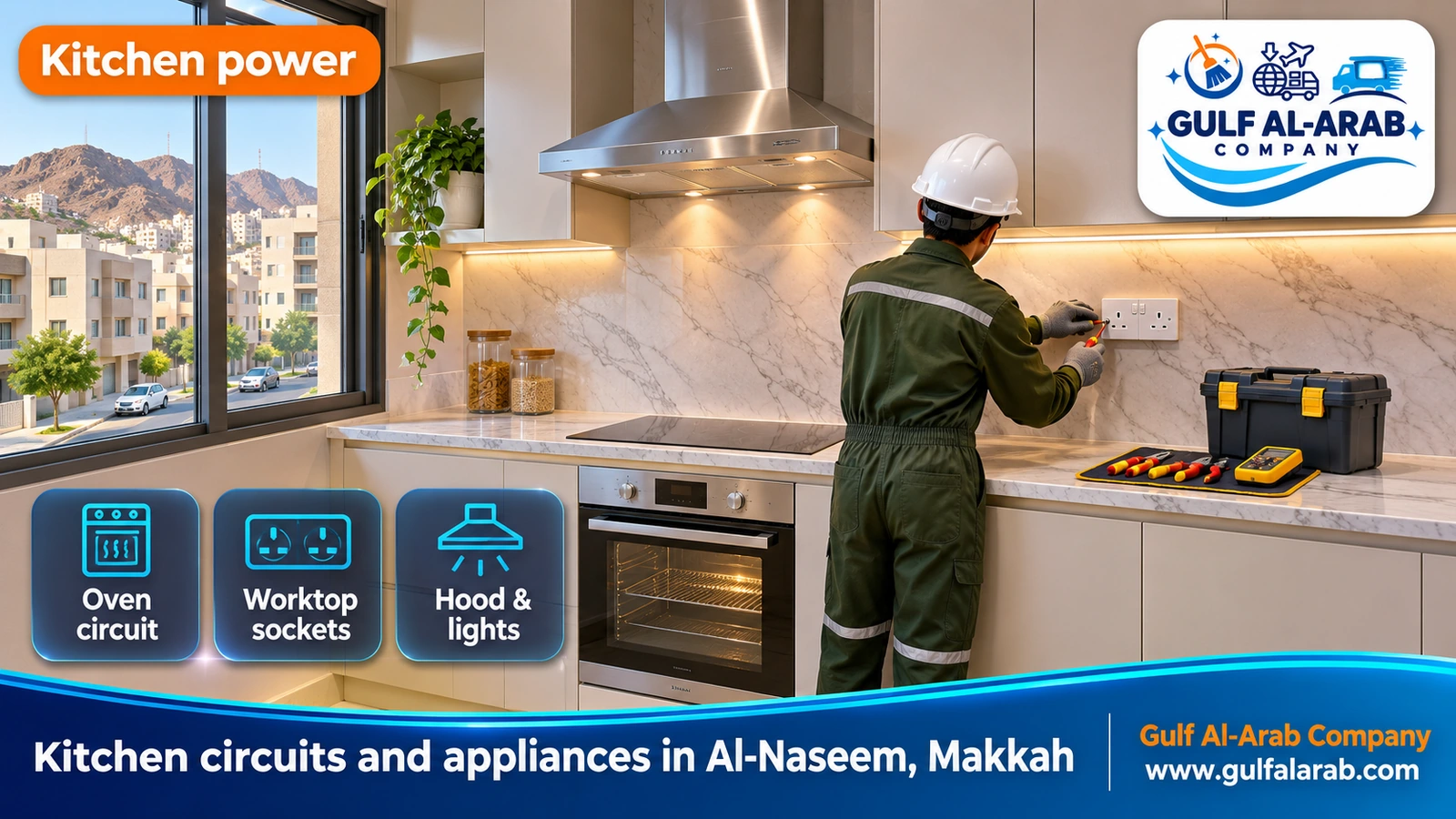
- Kitchens: dedicated lines for the oven and hob, counter-top sockets, under-cabinet and hood points
- Bathrooms: RCD protection for wet areas, covered sockets, extractor fans
- How to ask: send a photo of the heater or appliance and its rating plate to 0565564857
- Payment: after testing in front of you, with a workmanship guarantee
Why the work here starts in the bathroom and the kitchen
Al-Naseem is a residential district of apartment blocks and mid-size family homes. A typical flat has two or three bathrooms, each with its own heater, and a kitchen carrying far more than it was wired for: a built-in oven, an air fryer, sometimes a dishwasher, and often the washing machine too because there is no laundry room.
Each of these draws heavy current, and many were simply plugged into the nearest socket. Add summer air conditioning running at the same time and some circuits hit their limit. That is when you get repeated tripping, warm sockets, or a heater that never quite gets the water hot.
Rented flats add another twist. A new tenant brings a bigger heater or a different oven and plugs it into the old line as it is. We check the line before the appliance, because a cable that coped with a small heater may not cope with a larger one.
Water heater connection on its own line
A heater runs most of the day with water, heat and power in one box. We do not stop at “it works”. Four things have to be right before we call the job done:
- A dedicated line: cable sized to the heater, on its own breaker from the board, not a spur off a bathroom socket or the lighting circuit.
- A double-pole heater switch: it cuts both conductors, has a neon so you can see the heater is on, and sits outside the splash zone.
- Earth that is really connected: we test earth continuity right to the heater body. An unearthed heater is the most dangerous thing you can have in a bathroom.
- Leakage protection: the bathroom circuit sits behind an RCD that trips on a tiny leak before it reaches a person.
Heater trips the breaker
If it is the RCD that trips, the usual culprit is an element whose sheath has cracked and is leaking to the water or the tank, or moisture inside the connection box. If it is the ordinary breaker, it may be undersized for the heater or there may be a short in the cable. An insulation tester tells the two apart; we do not just reset it and leave.
Water lukewarm, or far too hot
Lukewarm water with the switch light on usually means a weak or burnt element. Water that gets scalding means a stuck thermostat. We test each separately and replace whichever has failed if the right part for your model is available.
Heater switch hot or blackened
That points to a loose terminal or a switch too small for the load, common where an ordinary light switch was used instead of a heater switch. We fit a proper heater switch and re-terminate the cable after trimming back the heat-damaged part.

Water and electricity in the bathroom: If you feel a tingle from the tap or the water, do not shower and do not touch the heater. Switch off the bathroom breaker or the main breaker straight away and call us. It means the heater is leaking current or the earth is broken, and it is not something to reset and leave until morning.
Kitchen circuits: a line for every heavy appliance
A modern kitchen is a small workshop. Our rule: anything that makes heat gets a line it does not share with other heavy loads, and anything near the sink is protected against leakage.
Built-in oven and electric hob
Built-in ovens and electric or induction hobs are among the heaviest loads in the house. They never go on an ordinary socket. They get their own cable, their own breaker and a fixed connection point behind the units. We read the rating plate first, because power varies a lot between models.
Hood and under-cabinet lighting
A hood draws little, but it sits over steam and grease, so its point goes somewhere hidden and clean. Strip lighting under the wall cabinets lights the worktop without shadows; we put it on its own switch or a touch sensor and leave the driver where it can be reached if it ever needs replacing.
Washing machine, dishwasher and fridge
Washing machines and dishwashers combine water with a motor and an internal heater, so they need their own earthed socket behind an RCD. For the fridge we prefer a socket it does not share, so it does not go off when something else trips the breaker while you are out.
Before you switch on a new appliance
| Appliance | What it needs | Sign the current wiring is not enough |
|---|---|---|
| Water heater | Own line, double-pole switch, earth, RCD | Hot switch, repeated tripping, lukewarm water |
| Instant heater | Heavier cable and a breaker matched to its high load | Lights dim the moment hot water runs |
| Built-in oven | Own line and a fixed connection point | Hot smell from behind the unit |
| Electric or induction hob | Own line, breaker matched to the rating plate | Trips when more than one ring is on |
| Washing machine, dishwasher | Own earthed socket behind an RCD | A slight tingle when touching the casing |
| Kettle, air fryer, microwave | Counter points spread over more than one circuit | Trips when two run together |
Your heater and kitchen on a safe line
Photograph the rating plate and the connection point, send them on WhatsApp, mention Al-Naseem, and we will book you in.
Call 0565564857WhatsApp 0565564857Bathroom safety that actually protects your family
The RCD is the most important part of a bathroom circuit. It compares current going out and coming back and trips on a leak far too small for an ordinary breaker to notice. The breaker protects the cable; the RCD protects people. The Saudi Building Code requires protection for wet areas, and we apply it in every bathroom we work in.
We keep bathroom sockets away from the shower and basin, with covers that keep water out, and put the extractor fan on a suitable point so damp does not sit inside the electrical boxes. In homes with small children we mount the heater switch out of their reach.
A one-minute monthly test: Your RCD has a small button marked T or Test. Press it once a month. If the RCD trips, it works; switch it back on. If it does not trip, it is not protecting you and needs replacing.
Mistakes we see in bathroom and kitchen wiring
- A heater on a plug-in socket, or on an ordinary light switch that slowly blackens under the load.
- A washing machine in the bathroom on an extension lead lying on a floor that gets mopped.
- Oven and hob sharing one socket behind a cupboard where nobody sees it until it smells hot.
- An earth wire cut or never connected in the heater box, while the heater carries on as if nothing is wrong.
- An RCD removed or left off because it “trips too much”, instead of finding the appliance that leaks.
Cutting heater running costs without cold showers
Heaters are one of the biggest items on a flat’s electricity bill, especially when every bathroom heater runs day and night. In summer many homes need only one heater on, because tank water already arrives warm. Setting the thermostat to a moderate level rather than maximum saves power and lengthens element life. A heater that runs for ages and still struggles is not saving anything either; a weak element just takes longer. Testing it and replacing the failed part gives you hot water and a lighter bill. We can also fit a timer on the heater line so it runs only before the times you shower.
How a visit works in Al-Naseem
- Call or WhatsApp 0565564857: your district, the appliance and what it is doing.
- Send a photo of the heater or oven rating plate, and of the connection point or board if you can.
- We set a time, sending an electrician the same day where possible, and tell you when he will arrive.
- The technician tests the line, measures earth and insulation, and decides whether the existing line is enough.
- He explains what he found and agrees the price with you before any work.
- He makes the connection, runs the appliance in front of you and presses the RCD test button.
- You pay once everything works. The job carries a workmanship guarantee; ask the technician about its period.
Parts are genuine. If you bought your own heater or switches, we fit them and tell you plainly if a part is too weak for the load.
Other electrical work in Al-Naseem
Beyond heaters and kitchens, the same technician handles the rest. Details are on the electrician in Makkah page.
Short-circuit tracing
Hidden faults in walls found with a thermal camera and insulation tester; partial outages fixed.
Boards
Board upgrades, breakers, RCDs, circuit labelling and load balancing.
Wiring
First and second fix for flats and annexes; rewiring older homes with minimal breaking.
Lighting
Heavy and standard chandeliers, spotlights, hidden LED, safe temporary occasion lighting.
AC and fans
Dedicated AC lines, ceiling fans and bathroom extractors.
Pumps
Tank pumps, float switches and rest-house pumps.
Security
CCTV, intercoms, doorbells, smart switches and TV mounting.
Other jobs
EV chargers, generator changeover, shop signs, furnished-flat checks.
What sets the cost in Al-Naseem
Electrical jobs are too different to price from a fixed list. A heater next to the board is not the same as one in an upstairs bathroom that needs a long cable run, and a large chandelier can need a lift and days of assembly. So the electrician prices the job once he sees it, or a photo or video of it on WhatsApp, and you agree before work begins.
| Job | What sets the price |
|---|---|
| New heater connection | Distance from the board, whether a dedicated line exists, the switch needed |
| Heater that trips or will not heat | What testing finds: element, thermostat or connections |
| Dedicated oven or hob line | Appliance rating, cable size and the route through units and walls |
| Counter-top sockets | Number of points, how they are split across circuits, hidden or surface |
| RCD installation | How many circuits it covers and space in the board |
| AC line with dedicated breaker | Distance to the unit and the existing load on the board |
| Inspection visit | The type of fault and the testing it needs |
Send a photo of the appliance and the connection point on WhatsApp and we will give you a price before the visit if the picture is clear enough.
Electrician near me in Al-Naseem, and next door
Yes, there is an electrician near you in Al-Naseem: 0565564857 for calls and WhatsApp. We also cover nearby districts, each with a page on the jobs most common there:
Book an Al-Naseem electrician now
We answer 24 hours a day. One photo of the fault on WhatsApp saves half the time.
Call 0565564857WhatsApp 0565564857