

Water tank cooler installation in Kuwait by Gulf Al-Arab Company covers choosing the right unit for your tank’s capacity, from a cooling fan to a smart cooler or a compressor unit with a coil, delivering it and lifting it onto the roof, fixing it, wiring it safely and setting the timer. A cooling fan with installation starts from KWD 56.500, and a compressor unit from KWD 228. Call or WhatsApp us on 65550977 and tell us your tank’s capacity and position.
In a Kuwaiti summer nobody needs convincing: you turn the cold tap and get water you cannot hold your hand under. This guide goes beyond a list of devices. It explains where the heat comes from, why a fan cools one tank and not another, when a compressor is worth the money, and what insulation can do before you buy anything at all.
At a glance
- Units: a cooling fan with blower and timer, a quiet smart cooler, and a compressor (chiller) unit with a coil inside the tank.
- Prices with installation: fan from KWD 56.500, smart cooler from KWD 72.500, larger smart coolers from KWD 125, compressor from KWD 228.
- Expected result: fans bring the water to roughly 25–30°C, compressors to around 20°C, according to sellers’ figures.
- Suits: plastic and fibreglass roof tanks, underground tanks, and villa and building tanks.
- Alongside: tank and pipe insulation and shading to improve cooling.
- Contact: call or WhatsApp 65550977.
Water tank cooler prices in Kuwait
Prices for cooling tank water in Kuwait start from KWD 56.500 for a cooling fan with blower and timer, installed, and goes up to KWD 228 and beyond for compressor units that chill the water with refrigerant. The price gap reflects a difference in principle: a fan pushes heat out, while a compressor actually pulls it from the water.
| Unit | From (KWD) | Suits | Expected cooling |
|---|---|---|---|
| Cooling fan with blower and timer | 56.500 | Tanks up to roughly 1,000 gallons | A noticeable drop in summer, not truly cold |
| Quiet smart cooler with timer | 72.500 | Homes bothered by fan noise | Close to a fan, with finer control |
| Larger smart cooler | 125 | Bigger tanks and heavy daily use | Temperature control and automatic running |
| Compressor unit with coil inside the tank | 228 | Villas, large tanks and anyone who wants genuinely cold water | Around 20°C depending on unit and capacity |
| Compressor for apartment blocks and buildings | After inspection | Buildings, mosques and commercial premises | Sized to the capacity |
| Servicing an existing cooler or replacing its fan | After inspection | Units already installed | — |
Why does the price differ from house to house?
The biggest factor is tank capacity: a 500-gallon tank needs only a small unit, while 2,000 gallons needs more power or two units. Then come the type of cooling, the brand and the availability of its spare parts in Kuwait, the length of the cable run from the distribution board to the roof, and whether the tank also needs insulation or a shade. Market prices themselves shift between winter and summer, because demand rises with the first heatwave, so those who install in spring save themselves the wait.
Some sellers in Kuwait offer instalments on larger compressor units. We give you a price covering the unit, installation and delivery before the appointment, so you can compare the full figure.
Where does the heat in tank water come from?
The heat in tank water in Kuwait comes from three sources: the sun striking the tank body all day, the hot air trapped above the water inside the tank, and exposed pipes on the roof that heat the water standing in them. On summer days the air goes above 45°C, and people in the trade say tank water can reach 55–60°C.
The third source is the one many people overlook. Even if you cool the tank, water standing in several metres of exposed pipe on a baking roof will come out hot for the first few seconds before it cools. That is why we check the pipe route before suggesting any unit, and insulating it is often part of the solution.
The effect of hot water goes beyond discomfort: showering in it at midday is harsh on the skin, especially for children and the elderly; the heat speeds up algae growth inside the tank; and it strains water heaters, washing machines and mixer valves. With ablutions five times a day, the household feels it more than at any other time.
A note for families
At midday in summer, test the water with your hand before children shower, even with the tap on cold: the first burst from the pipe may be hotter than you expect.
Tank coolers explained in two lines
Simply put, this device sits on top of the tank or next to it and lowers the temperature of the stored water, either by driving the hot air out from above the water and moving its surface so it loses heat, or by circulating refrigerant through a coiled pipe inside the tank that draws the heat out as an air conditioner does. The first is a cooling fan, the second a compressor or chiller, and in between sit smart coolers that pair a quieter fan with finer control.
How does a tank cooling fan work?
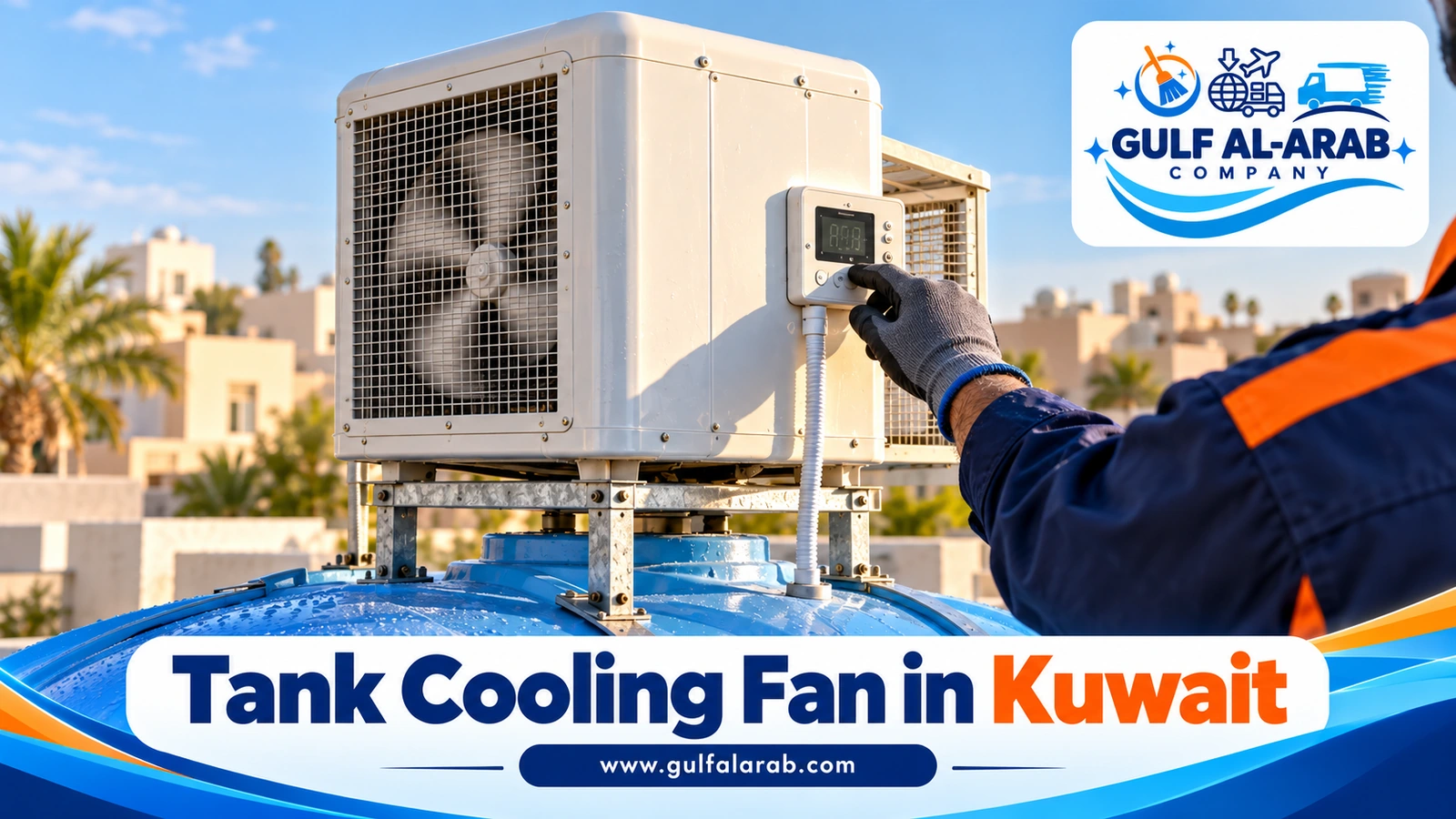
A tank cooling fan is fitted on the tank opening. It pulls out the hot, humid air trapped above the water and pushes in filtered air, so a little of the surface water evaporates and carries its heat away. It is the simplest and least costly solution, starting from KWD 56.500 installed.
The timer and running cycles
The fan does not run all day. Most units on the market have a timer that runs them for some hours and then rests them; sellers of one well-known type in Kuwait say it runs for 10 hours, rests for 2, twice a day, and draws about 3 amps. The aim is for the unit to work during the hours the water heats up, not at night when the air cools it anyway.
The limits of a fan you should know
A fan does not create cold; it brings the water close to the air temperature, or a little below it thanks to evaporation. So it works more clearly in dry weather and less on humid days near the sea. Because it relies on evaporation, the tank loses a small amount of water that the float tops up, so do not be surprised if the float works more in summer.
Sellers quote approximate results for tank fans of between 22 and 30°C after some hours of running. These are rough figures that vary with the tank’s colour, position and size and the heat of the day.
Solar-powered and no-power tank fans
Fans that run on a small solar panel are available. They work in daytime, when cooling is needed, and need no cable run to the roof. Their drawbacks are lower power and stopping when heavy dust covers the panel, so it needs frequent cleaning. A “fan” that runs with no power at all is really a ventilation cap relying on air movement; it helps a little but does not count as a cooler.
The compressor (chiller): real cooling for the water
A compressor or chiller unit cools tank water the same way an air conditioner cools a room: a compressor drives refrigerant through a copper coil inside the tank, which absorbs heat from the water and rejects it through an external condenser. With a thermostat and temperature sensor, the unit stops when the water reaches the set temperature. It starts from KWD 228 installed.

The parts of the unit and what each does
- Compressor: the heart of the unit; its capacity sets how large a tank it can cool.
- Coil: a coated copper pipe, or one made of a corrosion-resistant material, placed in the water.
- Condenser: rejects the heat the unit has drawn out; in most household units it is air-cooled with a fan.
- Thermostat and sensor: decide when the unit runs and stops, some with a digital display.
- Dry-run protection: some units have a sensor or float that stops them if the water drops below the coil.
Air or water condenser, and which compressors?
Air-cooled condensers are standard in homes because they need no extra water, but they struggle when the surrounding air is very hot, so they are best placed in a shaded, well-ventilated spot. Water-cooled condensers are used in large systems for buildings and factories because they are more efficient, but they need a water circuit and more maintenance. As for compressors, household units usually use reciprocating or rotary types, while large systems use screw and centrifugal compressors.
Sellers of one well-known compressor unit in Kuwait quote water reaching around 19–20°C. That is a temperature you feel in the shower as genuinely cold, and it is what makes the compressor the choice for villas with heavy use or large tanks.
Fan, smart cooler or compressor? A direct comparison
Choosing between tank coolers comes down to three questions: how cold you want the water, how much noise the household can live with, and how much you want to pay now and on electricity later. The image and table sum up the difference.

| Criterion | Cooling fan | Smart cooler | Compressor (chiller) |
|---|---|---|---|
| How it cools | Expels hot air, evaporation | Quieter fan with controls and sensors | Refrigerant and a coil in the water |
| Expected temperature | Roughly 25–30°C | Close to a fan | Around 20°C |
| Noise | Audible on the roof | Low | Moderate, like a small AC unit |
| Power use | Low | Low | Moderate to higher depending on capacity |
| Effect of humidity | Less effective on humid days | Less effective on humid days | Does not depend on dry air |
| Price installed | From KWD 56.500 | From KWD 72.500 | From KWD 228 |
| Best for | Homes on a limited budget | Households bothered by noise | Villas and large tanks |
Which unit suits your tank’s size and type?
A tank cooler is chosen first by capacity: small and medium tanks up to around 1,000 gallons are served by a fan or smart cooler in most homes, while anything larger, or anyone wanting really cold water, needs a compressor of the right size. Then come the tank type and position:
- Plastic roof tank: a fan sits on its opening or in place of its lid; a compressor’s coil enters through a suitable opening that is then sealed.
- Fibreglass tank: accepts every type, with openings sealed well to keep dust out.
- Underground tank: naturally cooler; the problem is usually the roof tank it pumps up to, so that is the one cooled.
- Several linked tanks: cool the tank that feeds the bathrooms directly, or split cooling according to the connections.
- Buildings and mosques: capacity is sized to total storage and use, and needs a site visit.
If the tank itself is old or leaking, deal with that first through water tank repair before fitting a unit on it, or choose an insulated replacement from water tanks for sale with layers that absorb less heat.
How much electricity does a tank cooler use?
A tank cooling fan is one of the lighter loads in the house. If it draws about 3 amps on Kuwait’s 240-volt supply, it uses around 0.7 kW, so ten hours of running is roughly 7 kWh a day. This is a rough calculation to help you compare; the actual figure is printed on the unit’s rating plate.
A compressor uses more, as it works like a small air-conditioning unit, but it switches off automatically once the water reaches the set temperature. Its consumption falls considerably if the tank is insulated and shaded, because less heat enters the water and the compressor runs for less time.
A tip that saves money
Set the timer or thermostat to the hours you actually need: mid-morning to sunset in summer. Running the unit all night on mild days adds little cooling and raises consumption.
Hot water in the bathroom this summer?
Send us a photo of the tank with its capacity and roof position, and we will suggest the right unit and its installed price.
Installing a tank cooler: what happens on the roof?
Installing a water tank cooler begins with a survey and choice of unit, then delivery and lifting to the roof, fixing it on or beside the tank, running a cable protected from water and sun, setting the timer or thermostat, and testing. A fan is far quicker to install than a compressor, which needs the unit fixed, the coil inserted and the opening sealed.
- Survey: tank capacity, type, colour and position, pipe route and distance to the distribution board.
- Delivery and lifting: we bring the unit in our own vehicles and lift it safely to the roof, which matters with heavy compressor units.
- Fixing: a fan on the tank opening or in place of the lid; a compressor on a firm base in a shaded, ventilated spot.
- Coil: for a compressor, the coil goes into the tank so it stays submerged, and its entry is sealed.
- Electrics: cable in a plastic conduit, a dedicated breaker, preferably an earth-leakage (RCD) breaker, and a waterproof junction box.
- Setting and testing: the timer or thermostat is set and running, noise and drainage are checked.
- Handover: we explain how to run and clean it and leave the roof clean.
Electrical safety on the roof
Do not accept a cable laid loose across the tiles or joined with tape under the sun. Roof wiring needs a protected conduit and a clearly marked breaker, because water, dust and heat meet there every day.
Insulation and shade: half the cooling before any unit
Insulating and shading a water tank cut the heat entering the water in the first place, so the unit runs less and cools more. In some homes, insulation, a shade and pipe lagging are enough for a clear improvement without any unit; in others, they are what allows the unit to do its job.
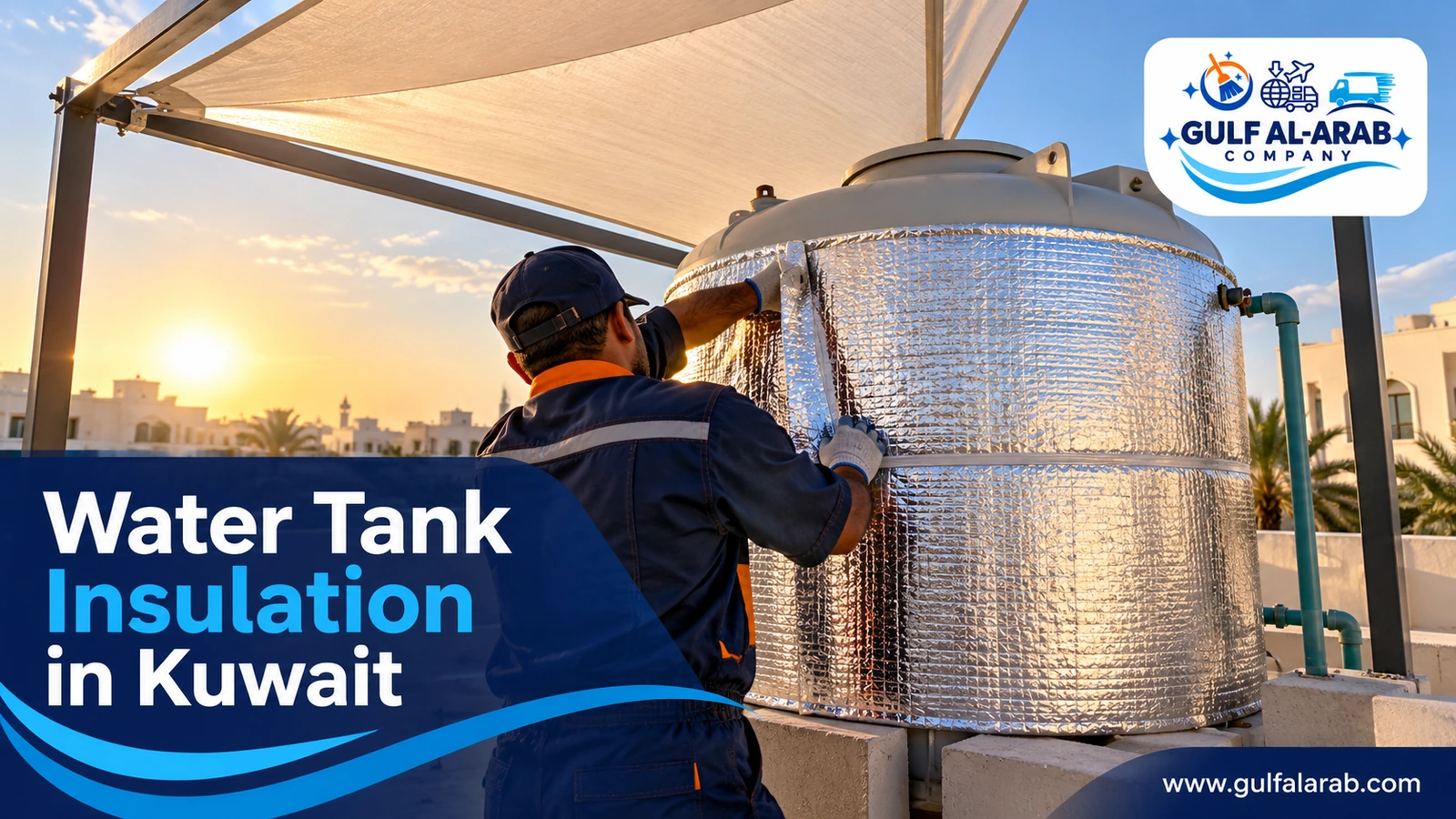
- Reflective jacket: a silver layer that reflects sunlight away from the tank body.
- Shade: fabric or sheeting on a metal frame that blocks direct sun while letting air through.
- Tank colour: light colours absorb less heat than dark ones.
- Pipe insulation: foam lagging around exposed pipes prevents the first hot burst.
- Roof insulation: a thermally insulated roof reduces the heat reflected onto the tank and the whole house; details in roof insulation in Kuwait.
Cooling shower and bathroom water: what is possible?
Many people look for a bathroom water cooler to fit under the basin or before the shower. In reality, the cold water reaching the bathroom all comes from the tank, so if it is hot in the tank, a small device it passes through quickly will not cool it. The practical solution starts at the tank itself and then the pipes running across the roof.
In homes where a bathroom is far from the tank and the pipe to it is long and exposed, insulating that one line changes the experience a great deal. If the water is hot in some bathrooms and not others, the likely cause is a pipe running past a heat source, such as an outdoor AC unit or a water heater.
Tank cooler brands found in Kuwait
Several names for tank coolers circulate in the Kuwaiti market, and each category has its own strengths. We list them so you know what to ask about, not to favour one name over another:
- Tank fans and blowers: such as Golden Star, Cool Shower, which fits in place of the tank lid, and other units under various trade names.
- Smart coolers: such as Aqua Cooler and similar units with timers and quiet running.
- Compressor units: such as Falcon, units built around compressors from well-known air-conditioning makers, some with an immersed coil.
When comparing brands, ask three things: are spare parts available in Kuwait, who handles after-sales maintenance, and what is the real capacity on the rating plate rather than in the advert. A cheap unit you cannot find a replacement fan for in two years is not cheap.
Water tank cooler maintenance
Maintaining a tank cooler means cleaning the air filter, blades and vents, checking the wiring and timer, and on a compressor, cleaning the condenser and checking the coil and pressures. Dust is the main enemy on Kuwaiti roofs, and a clogged filter is enough to leave a fan turning without cooling.
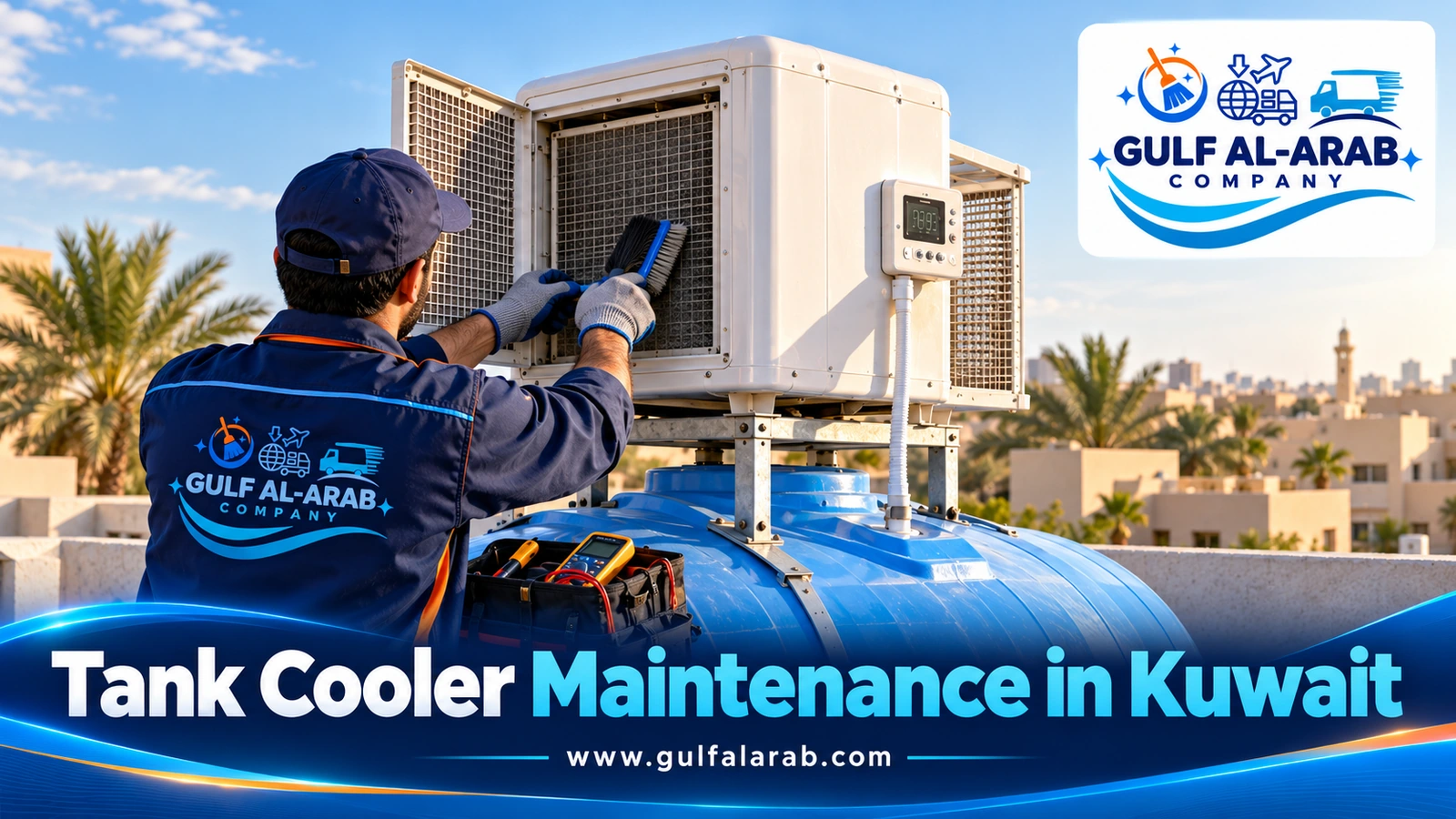
The table below is a simple year-round maintenance calendar that suits most household units.
| When | Fan and smart cooler | Compressor |
|---|---|---|
| Before summer | Clean filter and blades, check timer and cable | Clean condenser, check coil, sensor and pressures |
| Mid-summer | Clean the filter after dust storms | Clear dust from the condenser, listen for noise |
| End of summer | Cover or disconnect the unit if not in use | Set the thermostat for winter or switch off |
| When the tank is cleaned | Remove the unit and refit after cleaning | Clean the coil inside the tank |
Signs that call for a technician: a grinding or knocking sound, a fan turning slowly, a unit that trips the breaker, or water that no longer cools as it did last season. Send a photo and a short clip of the sound on WhatsApp 65550977.
Cooling tanks in villas, buildings and pools
Cooling large tanks in villas, apartment buildings, mosques and commercial premises needs a calculation of total capacity, the number of tanks and how they connect; a compressor is usually the practical choice because humidity does not affect it and it holds a set temperature. Factories and hospitals use larger cooling systems with water-cooled condensers and circulation loops.
Pools and water features are cooled with a circulation system that passes the water through a cooling unit and back, not with a fan on a hatch. That is a project studied on site, and we help with delivering, lifting and installing units alongside the party responsible for the design.
Before you buy: information to have ready
So we can suggest the right unit from your first message, have this information ready:
- Tank capacity in gallons or litres, its material and colour.
- Whether it is a roof or underground tank, and whether the house has more than one.
- Whether the tank is in full sun all day or partly shaded.
- The distance from the distribution board to the roof, and whether there is a socket nearby.
- How cold you want the water, and whether noise on the roof bothers you.
- Your rough budget, so we can suggest the best option within it.
If the water arrives with sediment or colour, cooling will not fix that; the answer is central water filters on the supply line.
Tank cooler installation across Kuwait’s six governorates
Our crews fit and look after tank coolers throughout the six governorates:
- Capital: Shuwaikh, Kaifan, Shamiya, Rawda, Adailiya, Qadsiya, Faiha, Nuzha, Khaldiya, Yarmouk.
- Hawalli: Salmiya, Jabriya, Rumaithiya, Bayan, Mishref, Salwa, Shaab, Hittin, Zahra, Siddiq.
- Farwaniya: Farwaniya, Khaitan, Jleeb Al-Shuyoukh, Omariya, Rabiya, Andalous, Rehab, Firdous, Ardiya.
- Ahmadi: Fahaheel, Mangaf, Mahboula, Abu Halifa, Fintas, Egaila, Sabahiya, Hadiya, Sabah Al-Ahmad.
- Jahra: Jahra, Qasr, Oyoun, Naseem, Waha, Taima, Saad Al-Abdullah.
- Mubarak Al-Kabeer: Sabah Al-Salem, Qurain, Adan, Qusour, Messila, Abu Ftaira, Fnaitees.
A cooler for your tank before the heatwave
Call or WhatsApp 65550977 with your tank capacity and area, and we will send you the options and their installed prices.