
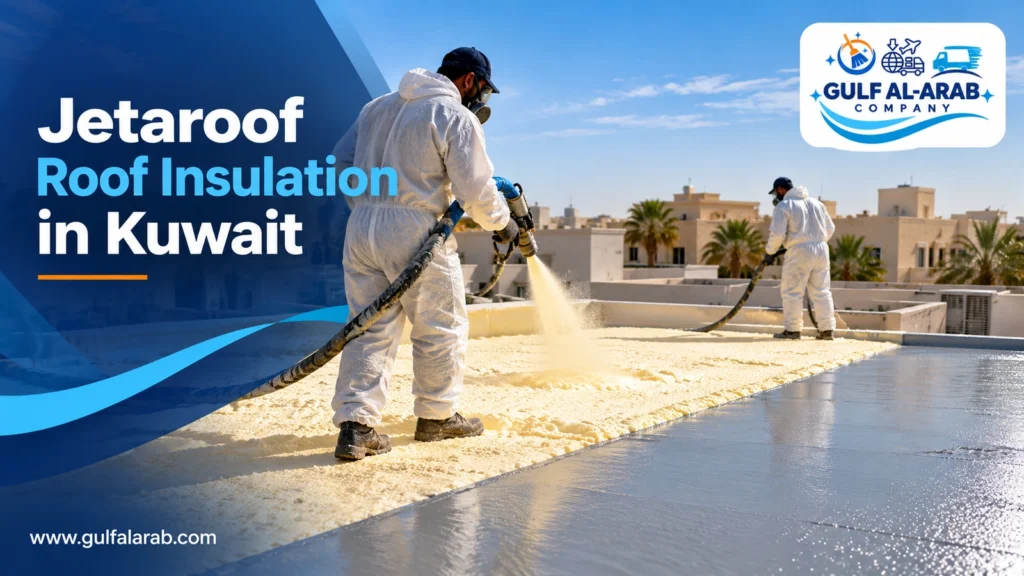
Gulf Al-Arab Company applies Jetaroof roof insulation in Kuwait for houses, villas, buildings and garages, along with American spray foam, bitumen membranes and thermal boards, starting with full roof preparation and ending with a water flood test before handover. Jetaroof starts from KWD 2.8 per square metre, and 3 cm spray foam from KWD 1.5 per metre. Call or WhatsApp us on 65550977 and send photos of the roof with its approximate area so we can suggest the right system.
Because we are a moving and general services company, we start with a step many contractors skip: clearing the roof of tanks, AC unit bases and stored items, lifting materials and equipment up by hoist or crane, then putting everything back once the insulation has cured. This guide explains the roof insulation types used in Kuwait, what each system costs and how you receive your roof fully tested.
At a glance
- Jetaroof: from KWD 2.8 per m², and the premium system with fibre mesh and a reflective coat from KWD 4.45.
- American spray foam: 3 cm from KWD 1.5, 4 cm from KWD 2.48 and 5 cm from KWD 3.45 per m².
- Waterproofing and thermal: bitumen membranes from KWD 1.85, thermal boards from KWD 2.95, and a dual system (foam with a Jetaroof coat) from KWD 4.6 per m².
- Special work: garages, annexes, Kirby roofs, tank insulation and pools.
- Handover: a flood test of at least 24 hours and a ceiling check from inside.
- Contact: call or WhatsApp 65550977.
Our insulation service: from clearing the roof to the flood test
Roof insulation in Kuwait at Gulf Al-Arab covers everything a roof needs from start to handover: inspection and measuring, clearing the roof and moving what is on it, cleaning and repairing cracks and corners, applying the agreed system, a flood test, and returning tanks and AC units to their places. We do not sell you a material; we deliver a roof that does not leak and does not load the house with summer heat.
- Waterproofing: liquid Jetaroof, torch-on bitumen membranes, cold and hot bitumen, polyethylene sheet.
- Thermal insulation: polyurethane spray foam, polystyrene boards, rock and glass wool, foamed concrete (Celton) and perlite.
- Dual systems: foam covered with a reflective Jetaroof coat, or bitumen with thermal boards under the tiles.
- Special areas: garages, canopies and annexes, Kirby and corrugated metal roofs, roof and ground tanks, pools and bathrooms.
- Support services: moving tanks, AC units and roof items, lifting materials, and cleaning the site after work.
Jetaroof: where the name comes from and what the Kuwaiti market means by it
In Kuwait, Jetaroof is the everyday name for a liquid roof insulation that is brushed or rolled on in coats to form a flexible, continuous membrane that stops leaks and reflects part of the sun. The name comes from Jotaroof by Jotun, an exterior paint designed for roofs that the company describes as twice as heat reflective, UV protected and resistant to algae, suitable for concrete, roof tiles, cement sheets and metal roofs.
Over time people in Kuwait began calling any white or grey flexible liquid coating applied with fibre mesh “Jetaroof”, and some applicators even use the word for bitumen rolls. So our first advice is simple: ask the applicator for the actual product name printed on the drum, the number of coats and whether a reinforcing mesh is used. We write that down for you before work starts, so you know exactly what is going on your roof.
Worth knowing
Jetaroof is mainly a waterproofing layer. Its reflective finish lowers roof surface heat, but it does not replace full thermal insulation. If your complaint is a hot top floor, foam or thermal boards with a Jetaroof coat on top are the better fit.
Price per square metre for each insulation system in Kuwait
Roof insulation in Kuwait at Gulf Al-Arab starts from KWD 1.5 per square metre for 3 cm spray foam, from KWD 2.8 for Jetaroof and from KWD 4.6 for a dual system. The prices below include materials, application and the flood test; the final price varies with area, roof condition and thickness.
| System | Insulation type | Approximate duration | Starts from (KWD/m²) |
|---|---|---|---|
| American spray foam 3 cm | Thermal and waterproof | One day for an average roof | 1.5 |
| American spray foam 4 cm | Thermal and waterproof | One day | 2.48 |
| American spray foam 5 cm | Thermal and waterproof for the hottest roofs | One to two days | 3.45 |
| Torch-on bitumen membranes | Waterproofing under tiles | One to two days | 1.85 |
| Liquid Jetaroof | Reflective waterproofing | One day plus curing | 2.8 |
| Premium Jetaroof with fibre mesh and reflective coat | Reinforced waterproofing | One to two days | 4.45 |
| Thermal boards | Thermal under the protection layer | Two to three days | 2.95 |
| Dual system: foam with Jetaroof coat | Complete thermal and waterproof | Two to three days | 4.6 |
| Garages and annexes, 3 cm spray | Thermal and waterproof | One day | 1.5 |
| Bituminous pool insulation | Waterproofing | Two to four days | 14 |
Tanks are priced per unit: insulating a small ground tank starts from KWD 138 and a roof tank from KWD 185. Moving tanks and AC units off the roof and back again is priced after we see roof photos, because it varies a lot from house to house.
What sets the final price?
The area (a small roof raises the rate per metre), the state of the old tiles and whether they are removed, the number of cracks, bases and drains, the foam thickness required, the type of top coat, and how easy it is to lift materials onto the roof.
Seven signs inside the house that your roof needs insulating
Your roof in Kuwait needs insulating when the signs appear inside the house before you see them on top: yellow or brown patches on the top-floor ceiling, paint that peels and bubbles, or a damp smell after the first rain. These signs mean water has entered the concrete and is starting to reach the steel reinforcement.
- Yellow patches or brown rings on the ceiling after rain.
- Bubbling or flaking paint near the corners of upper rooms.
- Hairline cracks in the roof tiles, especially around tank and AC bases.
- Stifling heat on the top floor even with the AC running for hours.
- Water that pools on the roof and does not find its way to the drain.
- Rust or crumbling concrete edges at the parapet wall.
- Summer electricity bills higher than in similar houses.
What Kuwait’s climate does to your roof
Kuwait’s climate is hard on roofs for two opposite reasons: a long summer in which shade temperatures pass 50°C and exposed roofs get much hotter, and a winter with few rainy days but downpours that can be heavy within hours. Expansion by day and contraction by night opens fine cracks in tiles and concrete, and then the rain seeps through them.
Add the dust that blocks drains and leaves water standing on the roof for days, and the coastal humidity in areas such as Salmiya and Fahaheel that speeds up rusting of steel. That is why Kuwait’s energy conservation code requires thermal insulation for building roofs, and why a single layer of tiles, however good, is not enough.
Leaks, heat or both? How we choose the system for your roof
We choose a roof insulation system in Kuwait from the problem you have, not from whichever material is fashionable. If the complaint is only leaking, you need waterproofing; if it is a hot top floor, you need thermal insulation; if it is both, the answer is a dual system. The table sums up what we suggest for the most common cases.
| Your roof | System we suggest | Why |
|---|---|---|
| New house before tiling | Torch-on bitumen with thermal boards, then tiles | Waterproof and thermal protection under a hard layer |
| Old tiles in good shape but a hot top floor | 4 cm spray foam with a reflective protection coat | No need to remove tiles, and foam fills every gap |
| Cracks and minor leaks, no heat complaint | Premium Jetaroof with fibre mesh | A continuous flexible membrane over the existing roof |
| Tired roof with leaks and heat together | Dual system: foam with a Jetaroof coat | Solves both problems in one seamless layer |
| Garage or annex with a metal roof | 3 cm spray foam from below or above | Stops heat, condensation and rain noise |
| Roof with constant foot traffic | Bitumen or boards under new tiles | Exposed layers suffer under heavy walking |
How Jetaroof is applied with fibre mesh, coat by coat
Jetaroof in Kuwait goes onto a clean, completely dry roof: a thinned primer, then two or three crossing coats with fibre mesh embedded between them, until the final film reaches about 1 to 1.5 mm. These are the steps our team follows:
- Pressure-wash the roof and leave it until fully dry.
- Treat cracks and joints with a flexible filler, and add a slight fall where water collects.
- Build a sloped cement fillet along the joint between roof slab and parapet, since coatings crack first at a sharp 90-degree corner.
- Apply a thinned primer that soaks into the concrete and bonds the coating to it.
- Apply the first Jetaroof coat, then lay the fibre mesh into it while wet, overlapping the edges.
- Apply the second coat once dry, at right angles to the first so no pores remain.
- Apply a third coat or a silver or white reflective finish for premium systems.
- Reinforce around tank and AC bases and drain outlets with extra mesh.
- Let the roof cure, then run the flood test.
Jetaroof strengths and limits
The main strengths of Jetaroof are that it goes over the existing roof without removing tiles, moves with the roof without cracking, reflects part of the sun and is easy to repair in patches. Its limits are that it is first and foremost waterproofing, its exposed top layer wears with sun and foot traffic so it needs recoating from time to time, and it does not take constant heavy traffic.
When does Jetaroof need recoating?
In Kuwait the Jetaroof top coat usually needs recoating every two to three years, depending on sun exposure and foot traffic. The signs are clear: a faded colour turning grey, a white powder that comes off on your hand, or fine surface cracking. Recoating on time costs far less than redoing the whole system.
American spray foam: 3, 4 and 5 cm and which suits your roof
American spray foam in Kuwait is liquid polyurethane sprayed onto the roof with a special machine; it expands within seconds and hardens into a seamless foam layer that insulates against heat and stops water at the same time. Two things decide its price and performance: thickness and density.
- 3 cm: for annexes, garages and small roofs, from KWD 1.5 per m².
- 4 cm: the most requested option for house and villa roofs, from KWD 2.48 per m².
- 5 cm: for the most exposed roofs, warehouses and commercial buildings, from KWD 3.45 per m².
The right foam for exposed roofs is closed-cell and high density (around 40 kg per cubic metre or more), because it does not absorb water and carries load. Open-cell foam is light and suits interior walls, not roofs. Foam also degrades under ultraviolet light, so it must have a protective coat on top, usually Jetaroof or a reflective paint; without one its surface yellows and crumbles within months.
Do not judge foam by its colour
An even colour does not mean the thickness has reached the target. Ask for thickness to be measured by pushing a marked pin into several points of the roof, and ask for the product name and its density as stated on the technical data sheet.
Bitumen membranes: the traditional waterproofing under the tiles
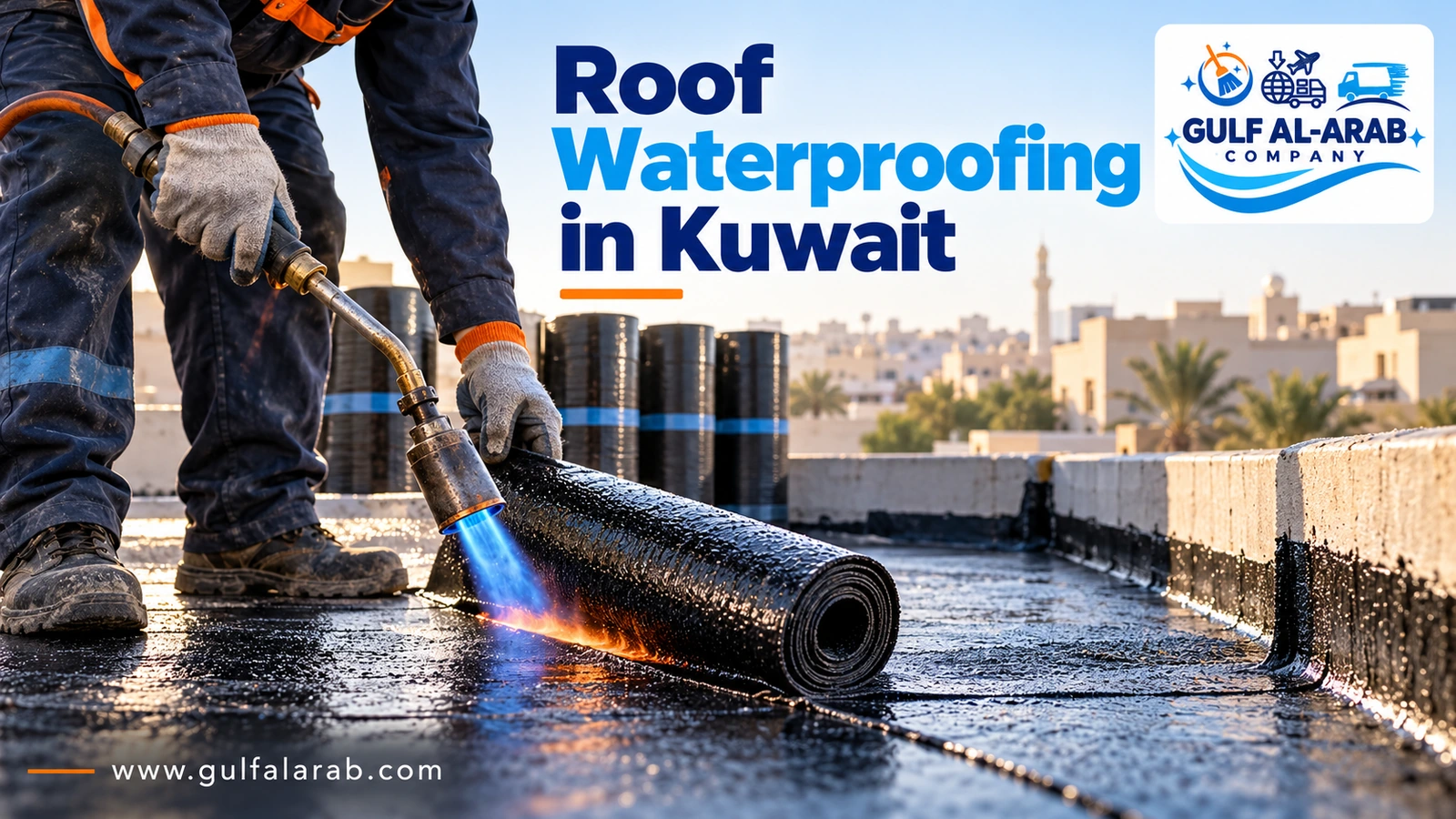
Bitumen membranes in Kuwait, often called “tarbal” or “rolls”, are black sheets 3 to 4 mm thick laid over a primer and welded with a gas torch, with edges overlapping by about 10 cm. They are the traditional choice for new houses or when the tiling is being replaced completely, because they go under the tiles and the protection screed, safely away from the sun.
Besides membranes there is cold bitumen, brushed on without heat and suited to small areas and foundations, and hot bitumen, melted and poured over the concrete. Black polyethylene sheet is a cheap separation layer laid under the screed to protect the waterproofing, but it is not enough on its own as roof insulation. Bitumen membranes start from KWD 1.85 per m² with us.
Polystyrene boards, wool and Celton: thermal insulation under the protection layer
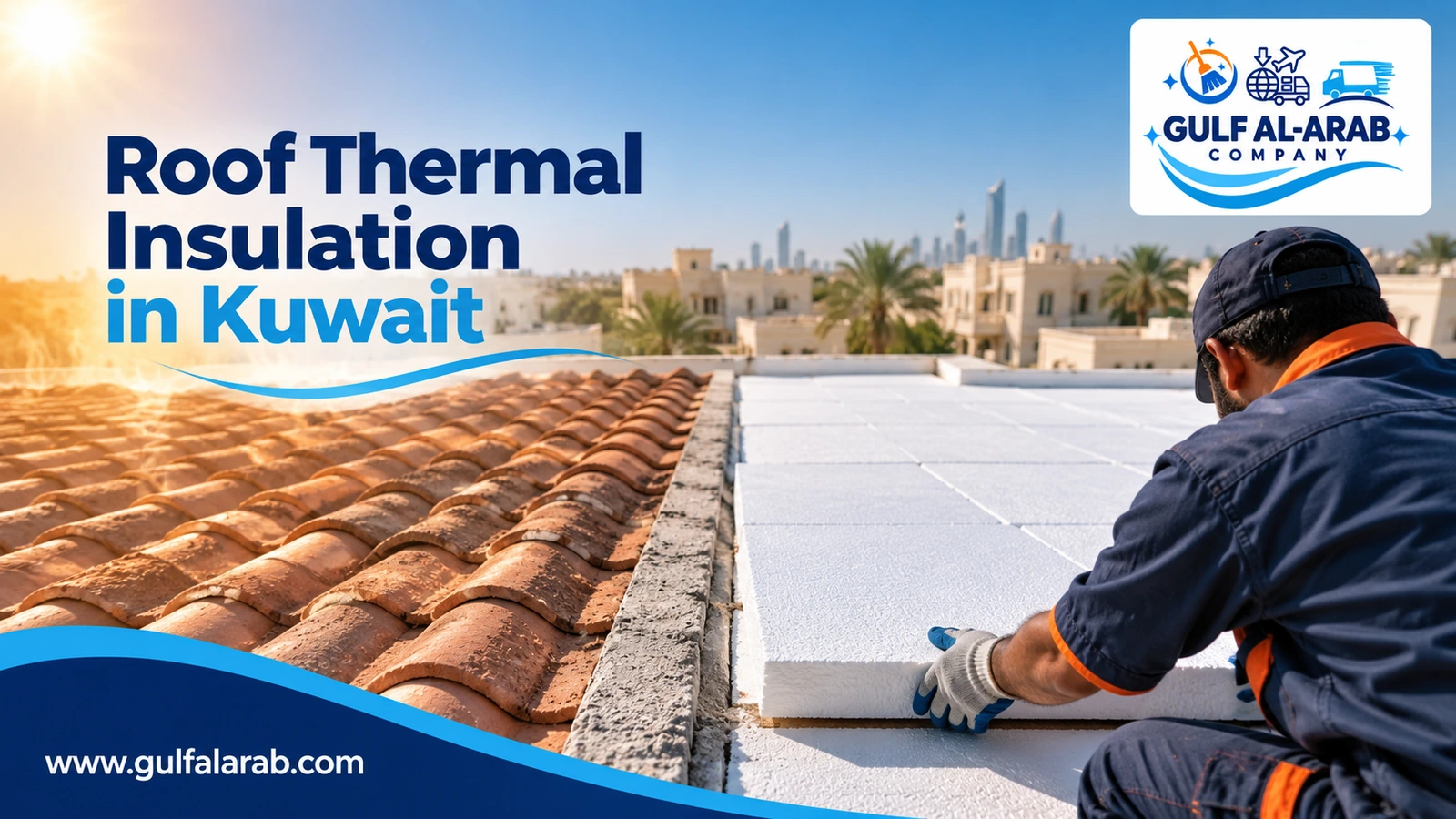
Thermal roof insulation in Kuwait uses boards or light materials that trap air and slow the flow of heat from the roof into the ceiling. The best known are extruded polystyrene boards (the rigid blue or pink boards) laid over the waterproofing and then covered with a screed and tiles; they start from KWD 2.95 per m² with us.
- Rock and glass wool: excellent thermally and fire resistant, used more in suspended ceilings and metal buildings because water damages it.
- Foamed concrete (Celton): an aerated, featherweight concrete that we pour to shape the roof slopes, and it insulates well too.
- Perlite: light volcanic granules mixed with cement for an insulating screed.
- Polyethylene: a separation sheet that protects the insulation from wet cement.
Jetaroof, foam, bitumen and boards side by side
The table puts the main roof insulation systems used in Kuwait next to each other so you can choose with your eyes open.
| Item | Jetaroof | Spray foam | Bitumen membrane | Thermal boards |
|---|---|---|---|---|
| Waterproofing | Excellent | Good with a protective coat | Excellent | Not on its own |
| Thermal insulation | Limited (reflective only) | Excellent | Poor | Excellent |
| Over existing tiles | Yes | Yes | No, under tiles | No, under tiles |
| Needs sun protection | Periodic recoating | Always | Covered by tiles | Covered by tiles |
| Foot traffic | Light | Moderate | Under tiles | Under tiles |
| Starts from (KWD/m²) | 2.8 | 1.5 | 1.85 | 2.95 |
Before any insulation: preparing the roof and fixing weak points
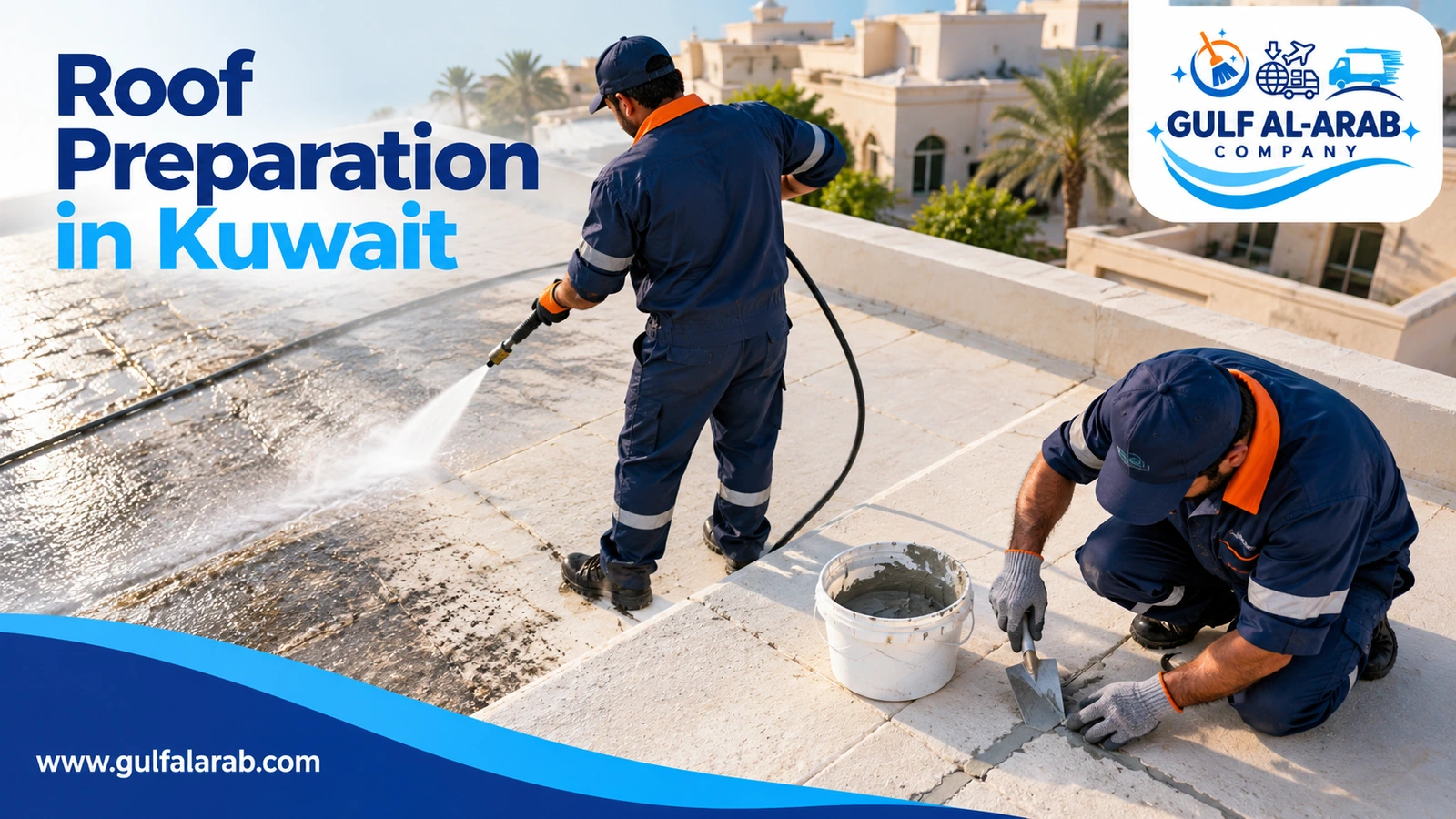
Roof preparation in Kuwait is half of a successful insulation job, because most failures start at a point that was never treated, not with the material itself. Before any layer we pressure-wash the roof, remove broken tiles and dust, fill cracks with a suitable compound, then apply the primer on a dry surface.
We pay special attention to the weak points typical of Kuwaiti roofs:
- Tank bases and the legs of their steel stands.
- AC unit bases and the openings for AC and electrical pipes.
- Drains and outlets that block with dust.
- The corner between the roof floor and the parapet wall.
- The stair room and its door threshold.
- Expansion joints on large roofs.
Clearing the roof and moving tanks and AC units before insulation
Clearing the roof before insulation in Kuwait is a step most insulation contractors leave out, so the homeowner has to find labourers and a crane themselves, or the coating is applied around the tanks and the area beneath them stays bare. Gulf Al-Arab is a moving company at heart: we move tanks after emptying them, lift outdoor AC units onto temporary stands, clear stored items off the roof, and put everything back once the insulation has cured, on new bases that do not cut into the layer.
We also lift heavy materials (foam drums, bitumen rolls and the spray rig) to the roof by hoist or crane instead of carrying them up the stairs, protecting your walls and staircase and saving hours of work. If the tank is old and you want to replace it at the same time, see water tanks for sale in Kuwait.
Leaking roof or a hot top floor?
Share roof photos and a rough size; we reply with a suitable system and a visit slot.
Insulating garages, canopies, annexes and Kirby or corrugated metal roofs
Garage insulation in Kuwait is usually done by spraying foam on the roof from below or above, because garage and annex roofs are often Kirby (prefabricated metal panels) or corrugated sheet that heat up fast and pass that heat to the car and the space. A 3 cm spray starts from KWD 1.5 per m².
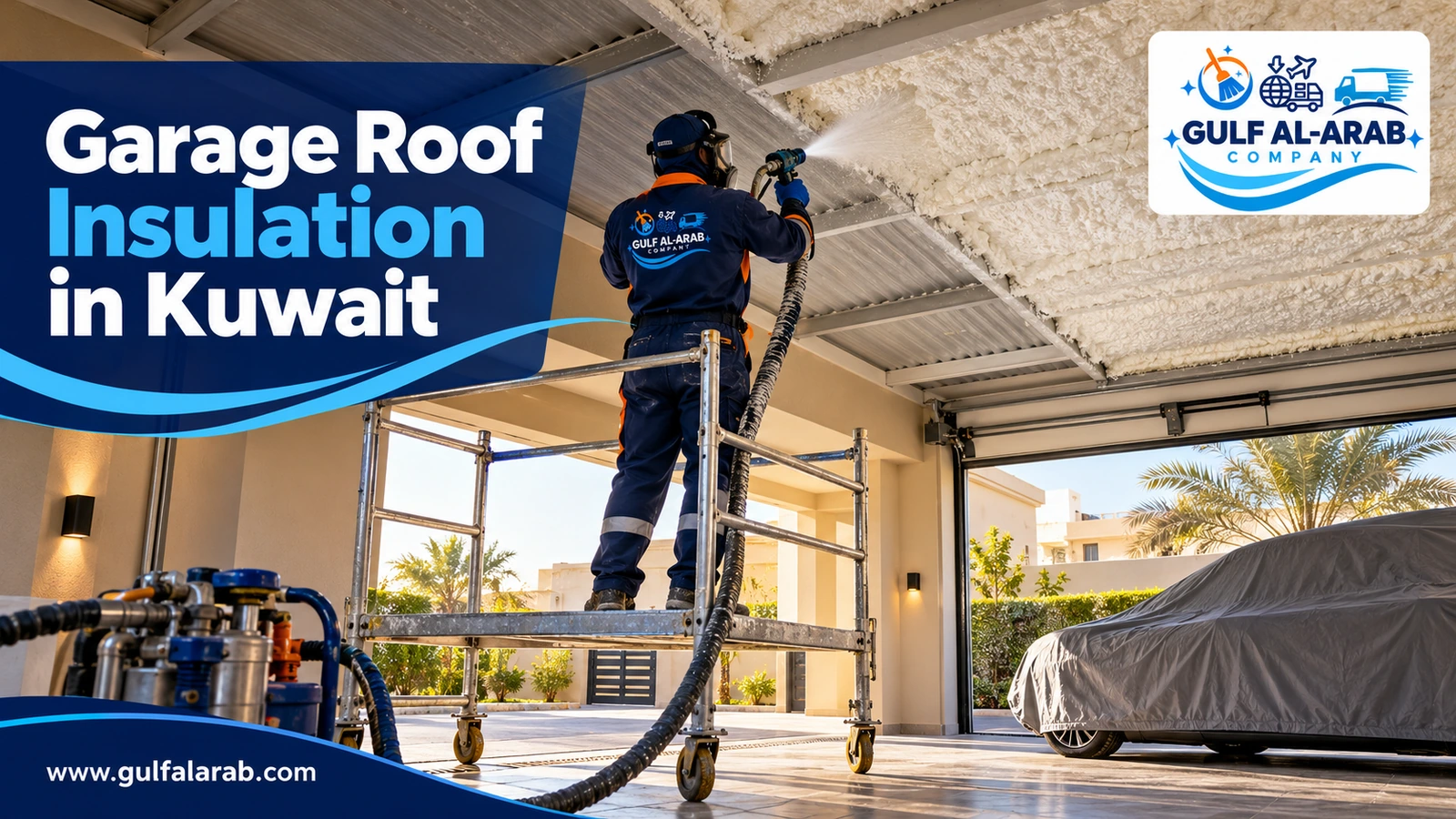
Spraying a metal roof does more than block heat: it stops the condensation that drips onto cars on winter nights, softens the drumming of rain on the sheets, and seals the gaps between panels so less dust gets in. Before spraying we cover cars, doors and walls with plastic sheeting, because foam overspray sticks to anything it reaches.
Thermal insulation for roof tanks and ground tanks
Insulating a Kuwaiti water tank keeps roof-tank water from reaching hand-scalding temperatures in summer, and protects a concrete ground tank from leaks and damp. Roof tank insulation starts from KWD 185 with us, and a small ground tank from KWD 138.
- Roof tank: polyurethane foam sprayed around it or a rock wool jacket, with a reflective cover or shade.
- Concrete ground tank: internal waterproofing with materials made for drinking water, and external bitumen before backfilling.
- Fibreglass tanks: repairing the layers and insulating them thermally from outside.
If the aim is genuinely cool water rather than just less heat, insulation alone is not enough; you will find complete solutions in our guide to water tank cooler installation. And if the tank shows a crack or leak, see water tank repair in Kuwait.
Pools, bathrooms and clear coatings over tiles
Pool insulation in Kuwait needs a system that withstands constant water pressure, so it is done in stages: cleaning, inspection and crack repair, then a primer, then the main waterproofing in two or three coats, then a protective coat and a fill test of 48 to 72 hours before tiling. Bituminous pool insulation starts from KWD 14 per m² with us.
In bathrooms and kitchens the waterproofing goes under the tiles before they are laid, turned up the walls a little around the floor. For anyone looking for a clear waterproofing over existing tiles or ceramics without breaking them, there are transparent coatings that seal grout pores and help with minor leaks, but they cannot fix a crack in the concrete beneath the tiles, so we decide after inspection whether they will be enough.
Which month and which hour? Timing insulation work in Kuwait
The best time to insulate a roof in Kuwait is autumn before the first rain and spring after the last, when roof temperatures are moderate and humidity is low. Work is possible all year round, though, as long as we respect each material’s conditions.
- In summer we start at dawn and finish before midday, because a very hot roof dries Jetaroof too fast and weakens its bond.
- We never spray foam onto a roof with morning dew or after rain, since moisture spoils the reaction.
- We postpone spraying on days of strong wind and dust, because overspray drifts and dust sticks to the layer.
- We do not torch-weld bitumen membranes on a wet roof.
- We check the weather forecast before Jetaroof, because rain in the first hours washes the coat away.
The 24-hour flood test: how you receive your roof
We hand over a roof in Kuwait after a flood test: we temporarily plug the drains, cover the roof with water a few centimetres deep and leave it for at least 24 hours, then check the top-floor ceiling from inside for any damp patch. If a patch appears, we locate the point, fix it and repeat the test.

- Foam thickness measured at several points.
- Adhesion checked by pressing by hand at edges and corners.
- Water confirmed to reach the drains once they are reopened.
- Tanks and AC units returned on bases that protect the layer.
- Photos of every stage handed to you with the product name and thickness.
After handover: simple care that keeps insulation going for years
How long insulation lasts in Kuwait depends as much on care as on the material. A roof whose drains are cleared before winter and where heavy things are not dragged across it keeps its insulation far longer than a neglected one.
| When | What to do |
|---|---|
| Before winter | Clear drains and outlets of dust and leaves |
| After every heavy rain | Go up and look for standing water or blisters |
| Every six months | Check around tank and AC bases and the stair room |
| Every two to three years | Recoat the Jetaroof top layer or the foam protection |
| Always | Do not drag heavy items or fix anything with screws through the insulation |
Before you agree with an insulation company: five questions
- What is the actual product name, and can I see the drum or roll before use?
- How many coats and what thickness, and how will you measure it in front of me?
- How will you treat corners, drains and tank bases?
- Does the job include a flood test, and for how many hours?
- Who moves the tanks and AC units and puts them back, and who is responsible for any damage to them?
A company that answers these questions clearly and writes the answers down before starting deserves more trust than whoever offers the lowest rate per metre.
On a tight budget: an economical option that will not let you down
The cheapest ways to insulate a roof in Kuwait are 3 cm spray foam for small roofs and annexes, bitumen membranes when the tiles are being replaced, and standard Jetaroof for minor leaks on a sound roof. The mistake we see most is choosing the cheapest option for a problem it does not solve: a thin Jetaroof coat for a family complaining about a hot top floor, or foam with no protective coat that crumbles after one summer. The truly economical choice is the smallest system that fully solves your problem.
Roofs we insulate in every governorate
We insulate roofs, garages and tanks in all six governorates of Kuwait. Some of the most requested areas:
| Governorate | Areas where we insulate roofs regularly |
|---|---|
| Ahmadi | Fintas and Mangaf, Mahboula and Abu Halifa, Egaila and Fahaheel, Sabah Al-Ahmad and Khiran |
| Mubarak Al-Kabeer | Sabah Al-Salem and Adan, Qurain and Qusour, Messila and Abu Fatira, Fnaitees |
| Jahra | Naseem and Oyoun, Qasr and Saad Al-Abdullah, Waha and Taima |
| Farwaniya | Ardiya and Andalous, Rabiya and Khaitan, Firdous and Abdullah Al-Mubarak, Sabah Al-Nasser |
| Hawalli | Bayan and Mishref, Salwa and Rumaithiya, Jabriya and Zahra, Salam |
| Capital | Kaifan and Khaldiya, Adailiya and Rawda, Yarmouk and Qadsiya, Nuzha |
Other Kuwait guides you may find useful:
Gulf Al-Arab Company: roof insulation
Call or WhatsApp us on 65550977 and tell us your area, roof size and the problem you see.